


 By neha - June 24, 2026
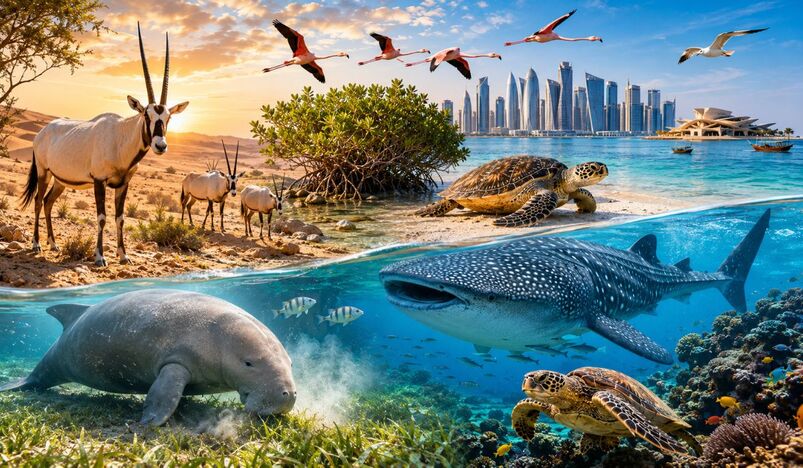
The Landscape That Shapes Qatar's Wildlife
Qatar covers just 11,571 square kilometres. That makes it roughly the size of Jamaica. It sits on a flat, low-lying peninsula jutting into the Persian Gulf, surrounded on three sides by some of the world's most biodiverse shallow seas.
On land, the interior is dominated by gravel and sandy desert, dune systems, and salt flats called sabkhas. Rocky outcrops appear in some areas. Rainfall averages around 80 millimetres per year. Summer temperatures regularly exceed 45 degrees Celsius.
Those conditions sound hostile to life. They are. But evolution is extraordinarily creative under pressure.
The animals that call Qatar home have developed remarkable adaptations. They extract moisture from food instead of drinking water. They burrow deep below the surface before dawn to escape the heat. They are active for just a few hours in early morning or after dark. Some spend months in a state of reduced activity between rain events.
Along the coastline, the story changes completely. Qatar's 560-kilometre coastline includes mangrove-fringed inlets, tidal mudflats, and shallow seagrass meadows. Those habitats support extraordinary marine biodiversity. The Persian Gulf here is warm, shallow, and nutrient-rich. It functions as a nursery for hundreds of fish species and a feeding ground for some of the largest marine animals on earth.

_03-27-2026_08-27.jpg)
.jpg)
.jpg)
.jpg)

.jpg)
.jpg)


.jpg)


.jpg)
.png)
.jpg)











Leave a comment