


 By neha - June 24, 2026

You finish another 10-hour day in Doha. The project deadline moved again. Your inbox has 47 unread messages. You have not had lunch. You cannot remember the last time you left the office before 8 pm.
You tell yourself this is normal. In the corporate world of Qatar, where ambition runs high, competition never sleeps, and expatriates are far from family networks, this feeling is disturbingly common.
But common does not mean acceptable. And it does not mean permanent.
This blog gives you practical, evidence-based mental health strategies that actually work inside a demanding corporate environment. Specifically, one built in Qatar, with its unique blend of culture, climate, and career pressure.
Why Mental Health in Qatar's Corporate World Demands Attention Right Now
Qatar's corporate sector has exploded. The country carries one of the highest GDP per capita figures in the world. More than 75 percent of its 2.9 million residents are foreign workers. Most are professionals working in finance, construction, energy, education, healthcare, and consulting.
For many, the rewards are real. The salaries are strong. The career exposure is broad. But the psychological pressure is real too.
A systematic review published in Social Science and Health in 2025 examined psychosocial risks across occupational sectors in the GCC region. It studied 165 research papers and found consistent patterns of stress, burnout, and reduced job satisfaction across multiple industries.
The Qatar Workplace Stress Management Market research confirms the scale. It found that organisations in Qatar increasingly face demand for mental health support, driven by rising workplace stress and growing awareness. Qatar's Ministry of Public Health reported a 35 percent increase in mental health awareness campaigns since 2020.
Globally, the 2024 Gallup Poll found that 62 percent of employees are disengaged at work. Lost productivity from unresolved mental health issues costs the global economy USD 8.8 trillion annually. Employees with unresolved depression experience a 35 percent drop in productivity.
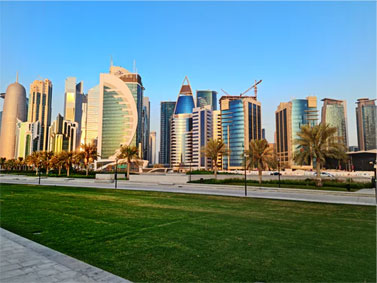
These are not abstract problems in some far-off economy. They are happening in the glass towers of West Bay and the sprawling campuses of Lusail right now.
What Makes Qatar's Corporate Environment Uniquely Challenging
Understanding the specific pressures helps you address the right problems.
The Expatriate Isolation Factor
Most corporate professionals in Qatar live away from their families. Many arrived alone, built their careers here, and maintain relationships across time zones. This geographic separation creates a chronic, low-grade loneliness that most people push down rather than address.
Hamad Medical Corporation (HMC), Qatar's principal public healthcare provider, identifies social isolation as one of the primary triggers for declining mental wellbeing. When you work long hours and your social support network is 3,000 kilometres away, the cumulative weight of that isolation becomes a genuine health risk.
The Heat and the Indoor Life
Qatar's summer temperatures regularly exceed 45 degrees Celsius. From June through September, most people spend close to 20 hours a day indoors. They commute in air-conditioned cars. They work in air-conditioned offices. They go home to air-conditioned apartments.
This climate-enforced indoor life reduces exposure to natural light, limits spontaneous physical activity, and cuts people off from the psychological benefits of time outdoors. HMC specifically recommends spending time in nature for mental wellbeing. In Doha summers, that window is genuinely narrow.
The Cultural Complexity
Qatar's corporate world draws people from over 100 nationalities. That diversity is a genuine strength. It is also a source of unspoken pressure. Navigating different communication styles, hierarchy expectations, and cultural norms across a single meeting room takes real cognitive energy.
Expatriates also often feel the pressure to perform at an elevated level. Visa status, accommodation, and family support are often tied to employment. Losing a job means losing your home. That kind of dependence intensifies work-related stress in ways that people in their home countries rarely experience.
The Stigma That Still Exists
Gulf Times and Lexology both documented a persistent pattern in Qatar's employment market. Mental health has historically been treated as a sickness rather than a workplace concern. Many employees fear that disclosing mental health struggles will trigger performance reviews, affect visa status, or damage professional reputation.
The 2025 NAMI Workplace Mental Health Poll found globally that two in five workers worry they will be judged if they discuss mental health at work. In a corporate culture where perception matters enormously, many Qatar-based professionals stay silent longer than they should.
The 10 Mental Health Tips That Work in Qatar's Corporate World
1. Name What You Are Actually Feeling
Most corporate professionals are fluent in the language of performance. They describe stress as being "busy." They describe anxiety as being "under pressure." They describe burnout as "needing a holiday."
Calling things by their real names is the first step toward addressing them. HMC describes the symptoms of declining mental health clearly. They include loss of enjoyment in things you usually love, persistent low energy, difficulty concentrating, avoiding people, sleeping badly, and feeling helpless about the future.
If you recognise three or more of these symptoms consistently over two or more weeks, you are not just tired. You are struggling. And that deserves real attention, not another weekend.
Naming it breaks the denial loop. You cannot address what you refuse to acknowledge.
2. Protect Sleep as a Non-Negotiable
Corporate culture glorifies working late. Qatar's business environment adds evening meetings across time zones. Ramadan schedules shift work rhythms dramatically. The result is a widespread sleep deficit that most professionals treat as normal.
It is not normal. It is dangerous.
Sleep is when your brain consolidates memory, processes emotional experience, repairs stress hormones, and restores executive function. Chronic sleep deprivation impairs judgment, increases emotional reactivity, and amplifies every stressor you face the next day.
HMC lists adequate sleep alongside physical activity and healthy diet as the three core foundations of mental wellbeing. Not as a luxury. As a foundation.
Protect seven to nine hours. Set a consistent sleep time even on weekends. Reduce screen exposure in the hour before bed. If sleep problems persist, speak to a doctor. Qatar's primary health centres offer sleep assessment and support.
3. Stay Physically Active Despite the Heat
Qatar's summer climate is a genuine barrier to outdoor exercise. But it is not a barrier to exercise itself. Every major hotel in Doha has a gym. Most residential compounds do too. Indoor malls have walking spaces. Swimming pools are widely available.
The research connection between physical movement and mental health is not gentle correlation. It is strong, replicated causation. Exercise releases endorphins and serotonin, reduces cortisol, improves sleep quality, and builds the physiological resilience that helps you manage stress.
HMC recommends keeping active both physically and mentally as a core part of protecting your wellbeing. KPMG's Future of Work Report 2024 found that 35 percent of Middle East employees leave jobs due to poor work-life balance. Physical activity is one of the most powerful tools for maintaining that balance.
You do not need an intense programme. A 30-minute walk in a climate-controlled environment three to five times per week is enough to produce measurable mental health benefits.
The early morning window from 5 am to 7 am is genuinely pleasant in Doha for most of the year. The Corniche, Al Bidda Park, and Aspire Park offer outdoor movement before the heat arrives.
4. Build Real Human Connection at Work
Professional relationships in Qatar's corporate world often stay surface-level. Colleagues come and go. Projects end. Many people cycle through Doha on two or three-year contracts and never build the kind of friendships that provide genuine support.
HMC identifies social connection as a primary protective factor for mental health. Fast Company Middle East reported that employees in the region who feel appreciated and connected to colleagues perform significantly better and report lower stress.
This means investing deliberately in relationships beyond professional necessity. Join a sports team, a running group, a book club, or a community volunteer programme. Qatar has a genuinely active expatriate community. It requires intention to access it, but it exists.
Within your workplace, create the habit of checking on colleagues. Ask a real question. Listen to the real answer. The 2025 Mind Share Partners report found that more than half of employees feel comfortable discussing mental health with a close friend at work. Those friendships need to be built before the hard moments arrive.
5. Set Boundaries Around Working Hours and Communication
Qatar's corporate environment does not always make it easy to stop working. Messages arrive at 11 pm. Managers send tasks on Friday afternoons. The line between being available and being always-on has effectively disappeared.
KPMG's research found that 38 percent of Middle East employees feel productivity expectations negatively impact their wellbeing. Fast Company Middle East documented that after-hours meeting culture is rising across the region.
A boundary is not a refusal to work hard. It is a recognition that sustained performance requires recovery. Athletes understand this. High-performing corporate professionals need to understand it too.
Set a communication end-time on weeknights. Turn off work notifications after that time. Communicate your boundaries clearly and professionally to your team. When leaders model boundaries, teams follow. You may contribute more to your organisation's culture by setting this example than by answering messages at midnight.
6. Eat Well in a Culture That Celebrates Excess
Qatar's corporate social calendar involves a great deal of food. Lunches, client dinners, Iftar buffets, and networking events built around restaurant settings create regular opportunities to eat in ways that undermine energy and mood.
HMC directly connects diet to mental wellbeing. The gut-brain axis means your digestive system and your brain communicate constantly. What you eat affects how you feel. A diet heavy in ultra-processed food, refined carbohydrates, and excess sugar drives energy crashes and mood instability.
Practical steps for corporate life in Doha include bringing lunch from home at least three days per week. Choose grilled over fried at client meals. Eat a proper breakfast before long workdays. Keep hydrated through the workday, particularly during Qatar's hot months when dehydration creeps up quickly in air-conditioned environments.
Qatar has excellent access to fresh produce at Lulu Hypermarket, The Pearl farmers' market, and specialty grocers across Doha. Eating well here is entirely possible. It requires planning, not sacrifice.
7. Use Mindful Breaks Instead of Scroll Breaks
Most corporate professionals take breaks by scrolling through social media or news feeds. This is not rest. Research on attention and cognitive recovery consistently shows that screen-based breaks do not restore focus. They extend mental fatigue.
A genuine break means visual and cognitive disengagement. Stand up. Look at something in the distance. Step outside the building for two minutes if the heat allows. Breathe deeply and slowly for five cycles. Sit quietly without a screen for five minutes.
These micro-recovery moments sound small. Over an eight to ten-hour workday they compound into meaningfully better concentration, lower afternoon stress, and improved decision quality.
HMC recommends relaxation techniques and breathing exercises as tools for mental wellbeing. These do not require a meditation retreat. They require five minutes and a quiet corner of your office.
The Islamic prayer schedule, observed by many colleagues and reflected in Qatar's built environment, actually provides a built-in framework for structured breaks during the workday. Even if you do not observe prayers, aligning your break schedule to these natural rhythms can help.
8. Create a Sense of Purpose Beyond the Job Title
One of the most consistent findings in wellbeing research is that people who feel their work has meaning report lower rates of burnout and depression than those who feel their work is purely transactional.
HMC recommends increasing your sense of purpose through activities like volunteering. Qatar has a growing community of volunteer organisations, particularly those serving migrant workers, children, and the environment.
Qatar Charity, the Qatar Red Crescent Society, and various community groups across Doha offer regular volunteering opportunities. Contributing to something larger than your KPIs creates the kind of psychological meaning that no salary package can replicate.
If volunteering feels like too much, find smaller moments. Mentor a junior colleague. Champion a project you believe in. Contribute your expertise to a cause. Purpose does not require a dramatic career pivot. It requires investing in something that genuinely matters to you.
9. Know Qatar's Mental Health Resources and Use Them
Too many corporate professionals in Qatar struggle alone because they do not know help exists or feel embarrassed to seek it.
The National Mental Health Helpline number in Qatar is 16000. This is a free, confidential service. You can speak to a mental health professional without visiting a clinic and without disclosing your name.
Hamad Medical Corporation provides mental health services through its network of facilities. Sidra Medicine, Naufar, the Mind Institute Qatar, and EAP Qatar also offer professional support.
The National Mental Health Strategy 2023 to 2030 mandates that organisations with more than 50 employees must provide access to mental health resources and stress management programmes. This includes Employee Assistance Programmes and digital counselling services.
If your employer has an EAP, use it. Many employees sign up, receive access, and never activate it. The confidentiality protections are genuine. The service exists because your employer has a legal and ethical obligation to support your wellbeing.
Qatar's Mental Health Law No. 16 of 2016 guarantees dignity, consent, and confidentiality for people receiving mental health care. Seeking help does not trigger employment consequences. The law explicitly protects treatment confidentiality.
10. Monitor Your Mental Health the Same Way You Monitor Your Performance
Corporate professionals track sales targets, project milestones, and quarterly reviews. Very few track their mental health with the same consistency.
Start a simple weekly practice. At the end of each Friday, spend five minutes asking yourself three questions. How did I feel emotionally this week on a scale of one to ten? Did I sleep enough? Did I do something this week that was not about work?
Patterns become visible over time. Gradual decline is much easier to course-correct than acute crisis. The HMC framework identifies warning signs like persistent low mood, loss of enjoyment, and sleeping badly. You catch these early when you are paying attention.
If you notice a downward trend over three or four weeks, do not wait for it to resolve itself. Talk to someone. A trusted colleague, a friend, your GP, or the 16000 helpline.
What Organisations in Qatar Can Do Right Now
Mental health is not only an individual responsibility. It is an organisational one.
Fast Company Middle East documented that 77 percent of employees work harder when they feel appreciated. Recognition is free. It costs nothing to tell someone their work mattered.
The following changes have measurable impact on employee mental wellbeing in Qatar's corporate context.
Flexible scheduling during summer months reduces fatigue from commuting in extreme heat. It improves focus and reduces resentment.
Mandated lunch breaks prevent the habit of eating at desks. A proper meal break improves afternoon productivity and signals that the organisation values recovery.
Mental health first aider training equips line managers with the language and skills to notice, name, and support colleagues who are struggling. This does not require a clinical qualification. It requires training and intention.
Regular, honest conversations about workload prevent the buildup of silent resentment that eventually turns into resignation or breakdown.
Removing the expectation of after-hours availability is one of the most powerful signals an organisation can send about its culture.
The Qatar Resources You Should Save Right Now
These are real services available to corporate professionals in Qatar.
- National Mental Health Helpline: 16000 — Free, confidential, available to anyone in Qatar.
- Hamad Medical Corporation Mental Health Services: Qatar's principal public mental health provider. Access through your GP or directly through HMC facilities.
- Sidra Medicine: Offers mental health assessment and treatment services in Doha.
- Mind Institute Qatar: Provides counselling and psychological support services.
- Naufar: Qatar's national rehabilitation and wellbeing centre.
- EAP Qatar (Employee Assistance Programme): Check with your HR department whether your employer subscribes to this service.
Qatar Counseling Center: Provides affordable counselling services across Doha.
If you are experiencing a mental health emergency or feel unable to cope, call 16000 immediately or attend the nearest HMC facility.
Frequently Asked Questions
Q: Is mental health taken seriously in Qatar's corporate sector?
The culture is shifting. Qatar's National Mental Health Strategy 2023 to 2030 now legally requires organisations with more than 50 staff to provide mental health resources. Awareness has grown 35 percent since 2020. But individual workplaces vary significantly. Know your rights and use the resources available.
Q: What are the signs of burnout in a corporate environment?
Persistent exhaustion that sleep does not fix. Cynicism about your work. Feeling detached from your team. Making more mistakes than usual. Dreading every Monday. Emotional numbness. If three or more of these persist for more than two weeks, seek support.
Q: Can I get mental health support in Qatar without it affecting my visa or job?
Yes. Mental health treatment in Qatar is protected by Law No. 16 of 2016. Confidentiality is a legal obligation of healthcare providers. Seeking help through your GP, the helpline, or an EAP does not trigger employment consequences.
Q: How does the Qatar climate affect mental health at work?
Extreme summer heat limits outdoor activity and natural light exposure for months at a time. This contributes to vitamin D deficiency, disrupted sleep patterns, and reduced physical activity. All three are linked to declining mood and energy. Plan indoor alternatives to outdoor activity during summer months.
Q: What should I do if I think a colleague is struggling mentally?
Acknowledge it directly and privately. Say something simple. Tell them you have noticed they seem tired lately and ask if they are okay. You do not need to diagnose anything. You need to open the door. Give them the 16000 helpline number. Do not wait for them to ask for help.
Q: Is it normal to feel lonely as an expatriate in Qatar?
Extremely common. Over 75 percent of Qatar's population is made up of foreign workers. Many arrive without established networks. Loneliness in that context is normal but manageable. Join community groups, sports teams, or volunteer organisations. Human connection requires investment. It is worth it.
A Final Word
Qatar gives corporate professionals an extraordinary platform. The salaries are competitive. The projects are ambitious. The exposure is global.
None of that matters if your mental health deteriorates quietly in the background.
Good mental wellbeing is not a reward for success. It is a prerequisite for it. HMC puts it plainly. Mental health problems affect around one in four people globally. Nobody is exempt. Not the high performer. Not the senior leader. Not the person who looks fine in every meeting.
You deserve support. You have the right to seek it. Qatar's systems are moving, imperfectly but genuinely, toward providing it.
Start with one tip from this list. One change. This week.
Then add another.

_03-27-2026_08-27.jpg)
.jpg)
.jpg)
.jpg)


.jpg)
.jpg)




.jpg)


.jpg)
.png)
.jpg)












Leave a comment