


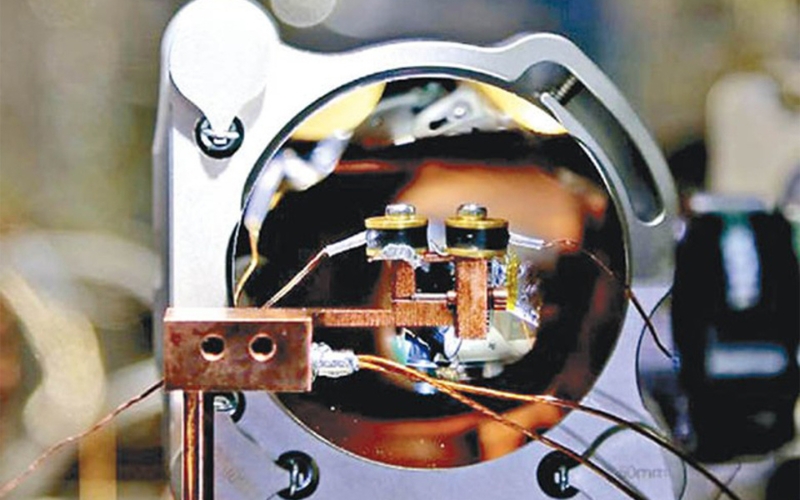
Beijing, October 12, 2026 : Chinese scientists have successfully developed and operated a nuclear clock under stable conditions, marking a potential breakthrough in precision timekeeping.
Zhai Hui, Chair of the Department of Physics at Tsinghua University, said the technology could pave the way for a new generation of time and frequency standards while advancing precision quantum metrology.
Unlike conventional atomic clocks, which measure changes in the energy levels of electrons surrounding an atom’s nucleus, nuclear clocks rely on energy transitions within the nucleus itself.
According to Xinhua News Agency, the newly developed clock uses lasers to trigger precise energy-level transitions in thorium-229, a radioactive isotope. The frequency of these nuclear transitions serves as the clock’s time reference.
If the technology can be developed for practical applications, it could improve the accuracy of satellite navigation systems, support deep-space exploration and enable ultra-precise measurements across various scientific fields.
Source: QNA