


 By neha - June 12, 2026
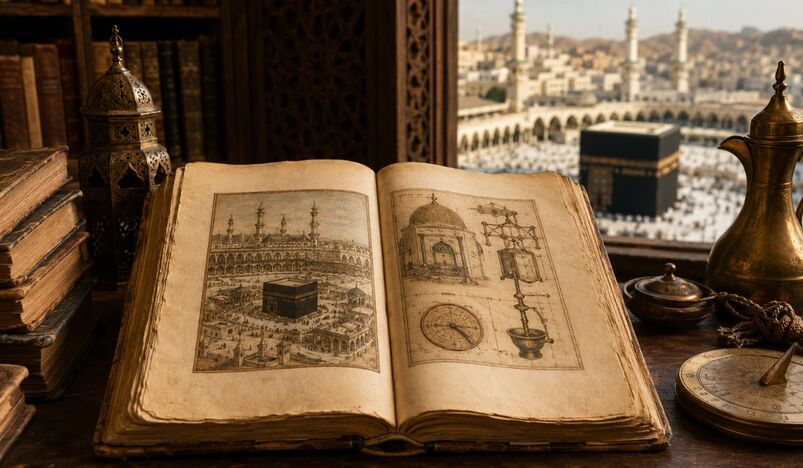
A 400-Year-Old Book Still Tells Us Something New
Most people know the Kaaba as Islam's holiest site. But what did it actually look like inside and around it 400 years ago?
Who tended the lamps? Where did the chief muezzin stand? How did engineers rebuild it after a flood?
A 17th-century manuscript answers all of that — with firsthand accounts, architectural details, and eyewitness descriptions no other source preserves.
That manuscript is Ikhbār al-Kirām bi-Akhbār al-Masjid al-Ḥarām (Informing the Noble of the History of the Sacred Mosque), written by the Meccan scholar Ahmad al-Asadī. Qatar National Library holds a rare Maghrebi copy today under the call number HC.MS.2016.0058.
Who Was Ahmad al-Asadī?
Ahmad bin Muhammad al-Asadī al-Makkī al-Shāfiʿī was born in Mecca in 1035 AH / 1625–26 CE. He was a scholar of Arabic language, grammar, Shafi'i jurisprudence, and literature.
He lived his entire life close to the Kaaba. That proximity gave him a rare advantage: he could write about the Sanctuary not from distant sources but from direct observation.
He died young — at just 31 years old — in 1066 AH / 1656 CE. He left the manuscript unfinished. His son later produced a fair copy and completed the remaining sections.
That detail alone tells you something important. This book passed through two generations before it reached readers. It carries both a father's witness and a son's devotion.
What Does the Book Cover?
The book covers three broad areas:
-
The Virtues of the Kaaba:
Al-Asadī opens with theological reverence. He describes the Kaaba as the direction of prayer, a sanctuary, and a place of return. He connects it to al-Bayt al-Maʿmūr — the Frequented House in the seventh heaven — circumambulated by 70,000 angels daily.
-
Architectural Descriptions of the Sacred Mosque:
This is where the manuscript becomes uniquely valuable. Al-Asadī describes the physical structure of the Sanctuary in careful detail — domes, stations, fountains, sundials, storage areas, and minarets.
-
The Ottoman Reconstruction of the Kaaba (1040 AH / 1631 CE):
Sultan Murad IV ordered the Kaaba rebuilt after a devastating flood. Al-Asadī was only five years old during this event. But he later met the men who built it. He interviewed engineers, carpenters, and laborers directly. He verified accounts and weighed different opinions critically.
No other known source preserves this level of construction detail from that reconstruction.
What Makes This Manuscript a Primary Source?
Scholars call a source "primary" when it comes from someone who witnessed events directly or interviewed those who did.
Al-Asadī qualifies on both counts.
He personally observed architectural works at the Sanctuary. He cross-referenced oral accounts from participants in the 1631 rebuilding. He cited earlier Meccan historical sources. And he applied critical judgment — comparing narratives and flagging where accounts disagreed.
That combination of direct observation, oral testimony, critical analysis, and written citation is rare in any era. In a 17th-century manuscript about a sacred site, it is exceptional.
A Passage Worth Reading Closely
One excerpt from the manuscript describes the area around the Well of Zamzam. It gives a vivid picture of the Sanctuary's daily operations:
Al-Asadī describes a roofed structure near the Siqāyat (drinking fountain) of Al-Abbas. It stored the instruments used for lamp management — the stands for lowering lamps, the reeds for extinguishing them, and the weekly oil supply. That location was later repurposed for storing construction materials like iron and wood.
He then describes the structure over the Zamzam Well — a square, roofed building topped by a lead-plated dome. It was renovated in 948 AH by Emir Khushqaldī.
Inside that structure sat a cabinet of timekeeping instruments (manākīb) used to calculate prayer times. Beside it stood a sundial (mizwala) that measured the elapsed and remaining portions of the day.
From that spot, the chief muezzin called the prayer and relayed chants during congregational prayers.
That one passage tells us: prayer timekeeping was precise, labor-divided, and spatially organized — centuries before modern scheduling tools existed.
The Manuscript's Journey: From Mecca to the Maghreb to Doha
The copy held at Qatar National Library is a Maghrebi copy — meaning it was transcribed somewhere in North Africa, not in Mecca.
This migration of the text matters. It shows the manuscript circulated widely across the Islamic world. Scholars in the Maghreb considered it valuable enough to copy and preserve.
The copy dates to the late 12th century AH / 18th century CE. That means readers were still actively engaging with this Meccan text more than 100 years after al-Asadī's death.
The manuscript eventually arrived in Doha, now preserved at Qatar National Library. It connects three geographies — Mecca, the Maghreb, and Qatar — across four centuries.
Why Does This Manuscript Matter Today?
Here are four specific reasons this manuscript holds lasting value:
Historical Specificity
Most general histories of Mecca describe broad periods. Al-Asadī records specific structures, tools, and personnel from a specific decade. That granularity is irreplaceable.
Architectural Record
Many features al-Asadī describes — certain domes, stations, storage rooms, lamp structures — no longer exist in their original form. His text is one of the only records of what they looked like and how they functioned.
Documentation of Ottoman-Era Meccan Life:
The manuscript captures daily religious and administrative life at the Sanctuary: who called the prayer, how they measured time, where tools were stored, how construction was managed. This is social history, not just architectural history.
Transmission of Islamic Scholarly Culture:
The manuscript itself — its copying, its migration from Mecca to the Maghreb to Qatar — illustrates how Islamic scholarly culture transmitted knowledge across regions and generations.
The Prologue of the Manuscript Sets the Tone
The opening lines of Ikhbār al-Kirām read like an act of gratitude. Al-Asadī praises God for honoring the Sacred House, for ordaining Hajj, for making Tawaf among the most virtuous acts, and for making the touching of the Black Stone a means for the remission of sins.
He frames the book as an act of bearing witness — to a House he knew personally, in a city he called home.
That personal investment runs through every page. He is not writing a detached encyclopedic entry. He is writing as a Meccan who loved the House and wanted its details preserved.
How to Access the Manuscript
Qatar National Library preserves this manuscript under the call number HC.MS.2016.0058. The library's Heritage Collection holds manuscripts from across the Islamic world, spanning centuries of scholarship in theology, science, literature, and history.
Researchers can explore QNL's digital collections and manuscript resources at qnl.qa.
The original blog post by Dr. Mahmoud Zaki, Information Services Librarian at QNL's Manuscript Section, is available at the Qatar National Library website.
Quick-Reference Summary
| Detail | Information |
| Manuscript Title | Ikhbār al-Kirām bi-Akhbār al-Masjid al-Ḥarām |
| Author | Ahmad bin Muhammad al-Asadī al-Makkī al-Shāfiʿī |
| Author's Life | Born 1035 AH / 1625 CE; died 1066 AH / 1656 CE |
| Subject | Kaaba history, Sacred Mosque architecture, Ottoman-era Mecca |
| This Copy's Origin | Maghrebi, late 12th century AH / 18th century CE |
| Current Location | Qatar National Library (HC.MS.2016.0058) |
| Unique Contribution | Firsthand accounts of the 1631 Kaaba reconstruction |
Frequently Asked Questions
Q: What is Ikhbār al-Kirām about?
It is a 17th-century Arabic manuscript about the history, architecture, and daily operations of the Sacred Mosque in Mecca. The author was a Meccan scholar who wrote from direct observation and firsthand accounts.
Q: Who wrote Ikhbār al-Kirām?
Ahmad al-Asadī, a Meccan scholar of grammar, literature, and Shafi'i jurisprudence, born in 1035 AH / 1625 CE.
Q: Why is this manuscript historically significant?
It provides the most detailed known eyewitness account of the 1631 Kaaba reconstruction under Sultan Murad IV, plus precise descriptions of Sanctuary structures and daily operations that no longer exist in their original form.
Q: Where is this manuscript today?
At Qatar National Library in Doha, under call number HC.MS.2016.0058.
Q: What era does the manuscript cover?
Primarily the Ottoman era in Mecca, with focus on the early-to-mid 17th century CE.

_03-27-2026_08-27.jpg)
.jpg)
.jpg)
.jpg)


.jpg)
.jpg)


.jpg)


.jpg)
.png)
.jpg)










Leave a comment