


 By Simran - June 22, 2026
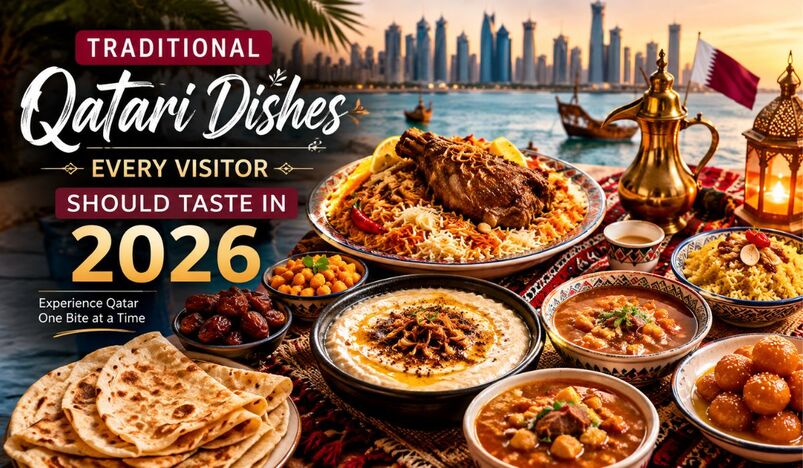
Qatar's food is not loud about itself. It doesn't wave its arms or demand your attention. It earns it, plate by plate, through layers of cardamom and saffron and slow-cooked patience that a busy restaurant kitchen simply can't fake.
This guide covers the dishes that actually matter — the ones Qatari families eat at home, the ones that show up at weddings and Ramadan tables, the ones you'll regret skipping. No fluff. Just what to order, where to find it, and why each dish is worth your time in 2026.
1. Machboos — The Dish That Defines Qatar
Every country has that one dish that people stop what they're doing to eat. In Qatar, that's Machboos.
It's a spiced rice dish, but calling it 'spiced rice' is like calling the Grand Mosque a nice building. The rice is cooked in a broth of dried lime (loomi), cardamom, cinnamon, and turmeric, then topped with slow-cooked meat — typically lamb shank, whole chicken, or fresh hammour from the Gulf.
What makes it specifically Qatari is the loomi — dried black lime — which gives the dish a tang that cuts through the richness. You won't find this combination quite like this anywhere else in the Gulf.
Where to eat it: Bayt Sharq inside the 100-year-old Al Khulaifi Heritage House in Old Doha. MICHELIN-recognised. Classic take, no shortcuts.
Also good at: Al Jasra Traditional Food, Souq Waqif — earthier, more home-style.
Machboos are traditionally shared from a large central platter, often seated on the floor. If you get invited to eat it this way, accept.
2. Harees — Seven Hours in a Pot
Harees is the kind of dish that takes all day and disappears in minutes. Whole wheat grains are slow-cooked with lamb or chicken — sometimes for six to seven hours — until everything breaks down into a smooth, thick porridge.
It sounds simple. It's not. The slow cooking extracts a depth of flavour from the meat that you can't rush. The final texture is silky, almost like a savory cream of wheat, and the best versions are finished with a pour of clarified butter (samn) right before serving.
Harees appears at the most important occasions in Qatari life. During Ramadan, you'll see it at nearly every Iftar table. At weddings, it feeds crowds of hundreds. There's a reason it's lasted centuries — it costs little to make, feeds many people, and tastes like it cost a lot to make.
Cultural note: Accepting a bowl of Harees at someone's home is accepting their hospitality. Don't rush it.
Where to eat it: Jiwan Restaurant at the National Museum of Qatar does a refined version. For the raw, home-style experience, walk into any Qatari eatery during Ramadan evening.
3. Thareed — Qatar's Answer to Everything Comforting
The 'Arabic lasagne' nickname is funny, but it's not wrong. Thareed is layers — torn flatbread at the bottom of a deep dish, then a slow-cooked stew of lamb or chicken and vegetables ladled over the top until the bread completely absorbs the broth.
The result is extraordinary. The bread swells and softens into something between pasta and stuffing, carrying the flavour of the stew in every mouthful. The vegetables — usually potato, courgette, carrots — go soft and rich. The meat falls apart.
Prophet Muhammad reportedly praised Thareed as the greatest of all foods. Qataris haven't forgotten that.
Where to eat it: SMAT Restaurant in Doha. Their madrouba and Thareed pairing is worth the trip alone.
4. Madrouba — Breakfast That Actually Fills You
Madrouba is often described as Qatar's answer to risotto, and the comparison holds up. Rice is cooked low and slow with chicken or fish, cardamom, cumin, black pepper and turmeric, stirred continuously until it becomes genuinely creamy — not thick with starch, but actually smooth.
It's finished with butter or ghee and often served warm in the morning. But 'breakfast food' undersells it — Madrouba is a full, proper meal at any hour.
The name comes from the Arabic verb meaning 'to beat' or 'to whip,' which refers to the stirring technique. Some families still cook it for hours over a low flame. The commercial versions cut that time. The family versions win.
Where to eat it: QIC Food Guide (updated June 2026) points to Ras Bu Fontas area restaurants for authentic home-style Madrouba.
5. Luqaimat — Eat These Standing
Luqaimat don't need a table. You eat them standing, straight from the paper cone, fingers sticky with date syrup, while the next batch is still frying in front of you.
They're small balls of yeasted dough — crispy outside, pillowy inside, coated in a thick poured date syrup (dibs) and sometimes a scatter of sesame seeds. At QAR 8–15 a portion from street stalls, they're the best-value food experience in Doha.
During Ramadan, Luqaimat carts appear across Doha from sunset onward. But you'll find them year-round at festivals, markets, and any gathering where someone wants to make 300 people happy with minimal effort.
Best spots: Chapati and Karak, Shay Al Shoomos. Street vendors in Souq Waqif area during evenings.
Pair with: Arabic coffee (qahwa) — the slight bitterness cuts the sweetness perfectly.
6. Grilled Hammour — The Gulf on a Plate
Qatar is a peninsula. Its food has always been shaped by the sea. Hammour — the Gulf's native grouper — is the fish that represents this relationship most honestly.
Caught fresh from the waters off the Qatari coast, Hammour has white, firm flesh that holds up well to whole grilling. The classic preparation is simple: scored fish, rubbed with garlic and coriander, grilled over charcoal, served with lemon and flatbread.
Don't let the simplicity fool you. Hammour caught and grilled the same day, over actual charcoal, has a sweetness and texture that imported frozen fish cannot replicate. This is a dish where freshness is the entire point.
Best restaurants: Seafood restaurants in the fishing harbour area of Doha. Al Shatt Restaurant is regularly mentioned in 2025–2026 local food guides.
Sustainability note: Hammour stocks have been under pressure. Some restaurants now source farmed Hammour. Wild-caught from day boats remains the preferred option.
7. Ghuzi — For When You're Feeding a Celebration
Ghuzi is not an everyday dish. It's a statement. A whole slow-roasted lamb is placed over a large tray of spiced rice — cooked with raisins, pine nuts, and fried onions — and brought to the table on a platter so large you wonder how anyone carries it.
The lamb falls off the bone. The rice underneath has absorbed every bit of fat and flavour from the roasting. The nuts add crunch, the raisins add sweetness, and the whole thing is eaten communally — hands reaching in, bread tearing, everyone sharing.
This is Qatar's hospitality made edible. When Qataris want to honour a guest, this is what they serve.
Where to find it: Most traditional Qatari restaurants offer a smaller version for two or four people. For the full ceremonial experience, some restaurants require advance booking.
8. Balaleet — The Sweet Breakfast Nobody Expects
Balaleet is the dish that surprises every first-time visitor. Sweet saffron-scented vermicelli noodles, cooked with cardamom, rose water and sugar — topped with a fried egg.
Sweet and savoury in the same bowl. It shouldn't work. It completely works.
The egg sits on top of the noodles, yolk intact, and you break it yourself. The richness of the yolk running into the sweet noodles balances everything. It's a distinctly Gulf breakfast and one that locals feel strongly about.
Cultural note: Balaleet is especially associated with Eid mornings. Eating it is almost a ritual — it signals that the celebration has begun.
9. Regag — The Crispiest Thing in Qatar
Regag is Qatari street food at its most stripped-down. A batter of flour and water is spread impossibly thin over a circular griddle and cooked within seconds into a crispy, translucent bread.
It's eaten plain, or with a fried egg cracked onto it mid-cook, or folded around fresh cheese. The texture is halfway between a crepe and a poppadom — delicate enough to shatter, but still warm and chewy at the centre.
Watching a skilled Regag maker work is worth standing around for five minutes on its own. The speed and confidence of that thin spread is genuinely impressive.
Where to find it: Souq Waqif, early morning before 9am. Some traditional food stalls set up specifically for the breakfast crowd.
10. Karak Chai — Not a Dish, But Mandatory
Karak isn't food, but no food guide to Qatar that omits it is doing its job properly.
Karak is black tea brewed strong, then simmered with evaporated milk, cardamom, saffron, and enough sugar to make your dentist uncomfortable. It's thick, sweet, intensely aromatic, and available from tea stalls across Doha for sometimes less than QAR 2 a cup.
It arrived in Qatar with South Asian workers decades ago and is now so embedded in local life that Qataris claim it as their own. Walking through Doha without stopping for Karak at least once is, frankly, a wasted trip.
Best stalls: Any independent tea stall in the Industrial Area or Souq Waqif area. Chain versions (like Chai Karak) are fine. The hole-in-the-wall originals are better.
Where to Eat Traditional Qatari Food in Doha (2026)
The restaurants below appeared in current 2025–2026 reviews and local food guides:
• Bayt Sharq (Old Doha) — Inside Al Khulaifi Heritage House, MICHELIN-selected 2025. Best Machboos in the city by most accounts.
• Jiwan (National Museum of Qatar) — Fine dining interpretation of Qatari classics. Go for Harees.
• SMAT Restaurant — Known for creative Madrouba and Thareed combinations. Casual, local crowd.
• Al Jasra Traditional Food (Souq Waqif) — Home-style cooking, full Qatari menu, no pretension.
• Chapati and Karak (multiple locations) — Best Luqaimat in the city. Honestly.
A Final Thought
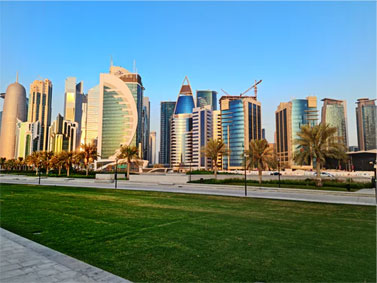
Qatar builds things fast. The skyline changes year to year. But the food moves at the pace of the slow-cooking pot — unhurried, deeply traditional, shaped by centuries of trade routes and desert and sea.
The ten dishes in this guide are not tourist reconstructions. They're what Qatari families eat. If you get the chance to eat any of them in someone's home, take it without hesitation.
_20-08-2026_05-08.jpg)
_27-51-2026_11-51.png)
_27-43-2026_12-43.png)


.jpg)
.jpg)

.jpg)


.jpg)
.png)
.jpg)










Leave a comment