


 By admin - April 24, 2026
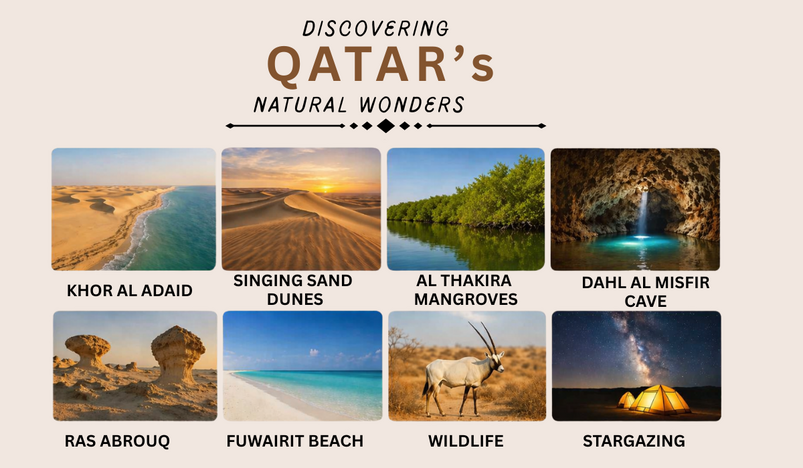
Most visitors never leave Doha. Here's what they're missing — deserts that meet the sea, singing dunes, ancient mangroves, and a cave that glows.
Qatar is easy to misread. Its global reputation rests on futuristic architecture, luxury hospitality, and high-profile events — and all of that is real. But step outside the capital and a very different country comes into view. One defined not by what's been built, but by what's been left alone.
The landscapes here are stark, extreme, and genuinely rare. Desert gives way to ocean. Dense forest grows inside an arid climate. Crystals line the walls of underground caverns. These aren't hidden secrets so much as overlooked ones — places that exist openly but receive a fraction of the attention they deserve.
- 560km of coastline along the Arabian Gulf
- 40m height of the tallest dunes at Khor Al Adaid
- 300+ plant species found across the country
Where Desert Meets the Sea
Khor Al Adaid is, by any measure, an unusual place. Located in the southeast of the country, it's one of the very few places on Earth where towering sand dunes descend directly into saltwater. The transition is abrupt and dramatic — wind-sculpted hills dropping into a tidal inlet without warning. UNESCO recognised it as a protected reserve precisely because of this rarity.
"One of the few places on Earth where desert and ocean merge — not gradually, but all at once."
The dunes here reach 40 metres in height, and the experience of being among them is physical, not aesthetic. Visitors come for dune bashing in 4x4s, camel rides through open terrain, and the particular quality of silence that exists far from any city. There's very little infrastructure, which is, for many people, exactly the point.
- UNESCO-recognised reserve
- Dune bashing
- Camel trekking
- Desert camping
The Dunes That Move — and Occasionally Sing
Qatar's desert interior is not a static landscape. The dunes shift continuously, moving several metres each year as wind redistributes sand across the terrain. This constant movement means no two visits produce the same view.
What's less expected is the sound. Certain dunes — under the right conditions — emit a low-frequency hum when the sand is disturbed, either by wind or by movement across the surface. Scientists attribute this to the vibration of uniform sand grains in alignment, but standing in the desert and hearing it is a different kind of experience entirely. It's one of those natural phenomena that sounds implausible until you've witnessed it.
The same terrain that produces this effect also offers some of the best stargazing in the region. With minimal light pollution and clean desert air, the night sky here is exceptional — something often overlooked in itineraries focused on daytime activities.
Al Thakira: A Forest That Shouldn't Exist Here
On Qatar's northeastern coast, a dense belt of mangroves grows along a shallow inlet. Al Thakira is one of the country's oldest and largest mangrove reserves, and its existence in an arid peninsula that receives less than 80mm of annual rainfall is genuinely surprising.
The forest supports a layered ecosystem: flamingos, grey herons, osprey, and various wading birds use the shallow waters and root systems as nesting and feeding habitat. The mangroves themselves act as a carbon sink and coastal buffer — they're ecologically important, not just visually striking.
Kayaking through the narrow waterways is the most effective way to explore the reserve. The canopy closes overhead in places, the water is shallow and calm, and the contrast with Qatar's desert interior is total. It functions as a reminder that this country's environments are far more varied than the typical travel narrative suggests.
- Bird watching
- Kayaking
- Coastal ecology
- Flamingo habitat
Dahl Al Misfir: A Cave Beneath the Sand
In central Qatar, roughly an hour from Doha, a natural cavern drops 40 metres into the earth. Dahl Al Misfir — sometimes translated as "Cave of the Bright Light" — is formed from soft limestone, and its walls are lined with gypsum crystals that catch and refract light in ways that justify the name.
The cave has a mild phosphorescent quality in certain conditions, producing a pale, diffuse glow that early visitors compared to moonlight. Temperatures inside are noticeably cooler than the surface — a significant contrast during summer months when the desert above can reach 45°C.
It's not a developed tourist site. There are no guided tours, minimal signage, and the descent requires some effort. That's part of what makes it worth visiting — it exists as it is, without interpretation or management, and the experience of being inside it reflects that.
Ras Abrouq: Limestone Shaped by Time
The western coastline of Qatar contains some of the country's most visually strange terrain. At Ras Abrouq, centuries of wind erosion have carved the local limestone into mushroom-shaped formations — wide caps balanced on narrow bases, some reaching several metres in height. The effect is genuinely alien.
This part of Qatar also supports a small but visible wildlife population. Arabian oryx — reintroduced to the region after near-extinction — roam the flat terrain alongside desert foxes and various reptile species. The combination of sculpted rock, open desert, and active wildlife makes Ras Abrouq one of the more complete natural experiences available in the country.
Qatar's Coastline and Marine Life
Over 560 kilometres of Arabian Gulf coastline means Qatar has significant coastal variety. The beaches range from urban waterfronts to remote, undeveloped stretches that see almost no visitors.
Fuwairit Beach
Among the more ecologically significant is Fuwairit Beach, in the north of the country. Its white sand and clear, shallow water make it a popular destination for swimming and kitesurfing, but what sets it apart is its role as a nesting ground for the hawksbill turtle — a critically endangered species. Nesting activity is monitored and protected during the season, and the presence of these turtles places Fuwairit within a narrow category of beaches with genuine conservation value.
Qatar's waters also host whale sharks, particularly during certain seasonal periods when water temperatures and conditions align. Marine biodiversity here is rarely discussed in the context of Gulf travel, but it is real and well-documented.
Desert Wildlife: More Than It Appears
Qatar's harsh climate — hot, arid, and prone to sandstorms — doesn't suggest a rich biological environment. But the country supports over 300 plant species, including desert-adapted flora that survives on minimal water and high salinity. After rare rainfall events, sections of the desert transform within days, producing temporary green cover that's visible from some distance.
Seasonal bird migrations bring flamingos and other species in large numbers to coastal and inland wetland areas. Permanent residents include the Arabian oryx, sand gazelle, desert fox, and a range of reptiles adapted to the temperature extremes. The marine environment adds whale sharks, rays, and various reef species to the count.
"After rain, parts of the desert turn green within days — life here adapts rather than disappears."
A note on what Qatar's natural side actually requires: None of these places are difficult to reach from Doha, but most require intent. They don't appear on the standard itinerary, they're not heavily marketed, and a few involve some physical effort to access properly. That's precisely what makes them worth the trouble. Qatar has built an international profile around its urban and cultural offerings — and those are legitimate. But the country's natural geography is equally distinctive, and almost entirely overlooked by the visitors who come here every year.

_20-08-2026_05-08.jpg)
_27-51-2026_11-51.png)
_27-43-2026_12-43.png)


.jpg)
.jpg)



.jpg)


.jpg)
.png)
.jpg)











Leave a comment