


 By neha - June 25, 2026
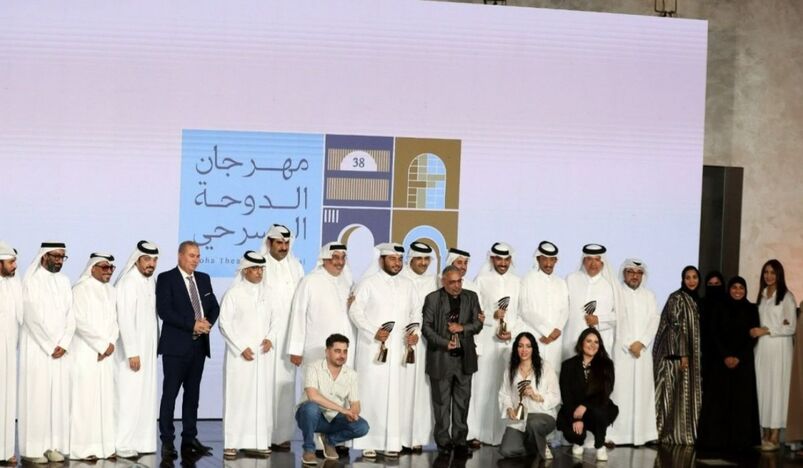
Qatar's Minister of Culture HE Sheikh Abdulrahman bin Hamad Al-Thani stepped onto the stage at the Dukhan Hall Theater on Wednesday night and handed out the awards that closed one of the Arab world's oldest and most enduring theatre festivals. The 38th Doha Theatre Festival ended with Qatar Theatre Group taking home five of the night's top prizes — a near-total sweep that reflected the group's depth, preparation, and sustained creative investment.
The ceremony took place at the Ministry of Culture's headquarters in Doha, in front of an audience of artists, cultural figures, and theatre practitioners. It marked both a celebration of this year's winners and a tribute to those who built Qatari theatre before them.
Qatar Theatre Group Wins Five Awards in a Single Night
The Qatar Theatre Group's production dominated the 38th edition's competitive lineup. The group's play, "The Dividing City," written by Taleb Al-Dos and directed by Mohamed Youssef Al-Mulla, won five awards across nearly every major category.
The five wins were: Best Overall Production, Best Script (Taleb Al-Dos), Best Scenography, Best Director (Mohamed Youssef Al-Mulla), and Best Actor (Nasser Habib).
That haul left very little room for the other competing groups. Best Actress was the only top award that went elsewhere — and it went decisively to Amina Al-Wakiili for her performance in a play by the Doha Theatre Group.
The Three Competing Plays and Who Judged Them
This year's festival ran from June 21 to 23 at the Al-Mayassa Theatre inside the Qatar National Convention Centre (QNCC), before the closing ceremony moved to the Dukhan Hall Theater.
Three amateur theatre groups competed across three evenings. The Doha Theatre Group opened the festival with "Under the Rubble," written by Yasser Al-Hassan and directed by Faleh Fayez. The Qatar Theatre Group followed with "The Dividing City" on the second evening. Al-Watan Theatre Group closed the competition nights with "The Black Heel," written and directed by Shuaib Al-Kuwari.
The jury that evaluated all three productions comprised actor Ghazi Hussein, critic Dr. Nizar Shukroun, and artist Khalid Abdul Karim Al-Hammadi. Their task was to assess performance, direction, script quality, scenography, and production value across all competing works.
A Director Who Has Now Won Three Times in a Row
Mohamed Youssef Al-Mulla's Best Director win at this year's festival was not his first. It was not his second either. He has now won the Best Director award at the Doha Theatre Festival for three consecutive years — a distinction that places him in a category of his own in the current Qatari theatrical landscape.
Al-Mulla acknowledged the weight of that recognition while remaining clear-eyed about what it demands.
"I am happy to win the Best Integrated Work award for the third consecutive time at the Doha Theater Festival," he said. "This repeated recognition places greater responsibility on me to further develop my directing experience."
He was also careful to share the achievement with everyone involved. "The win represents a collective effort involving the entire team," he said. "The multiple awards reflect the scale of work invested in the production."
That framing — success as collective rather than individual — reflects a values system that runs through the entire festival's philosophy.
Qatar Theatre Group Supervisor on Young Talent
Qatar Theatre Group supervisor Nasser Abdul Raza used the moment to reflect on what five awards in a single night actually represents.
He said the results achieved by the group in this edition reflect its continuous efforts to attract and refine young talents. He described the competition as strong across all categories. The awards, in his view, are not a destination. They are motivation.
"The competition was strong among nominees in all categories," he said, "and the awards are a motivation to continue producing more distinguished works in the future."
That dual perspective — celebrating achievement while treating it as a baseline for the next push — defines Qatar Theatre Group's approach. Three consecutive Best Director wins for Al-Mulla are one measure of it.
Honoring the Builders of Qatari Theatre
The closing ceremony did more than award the living. It also paid tribute to those who built Qatari theatre across previous generations.
This year's annual festival book, released by the Theatre Affairs Centre to coincide with the 38th edition, included a tribute to four prominent Qatari artists and theatre figures who passed away and left behind lasting legacies. The four honoured posthumously were artist Mohammed Al-Balm, director Talal Al-Siddiqi, Dr. Ahmed Abdulmalik, and artist Khalifa Jumaan.
Each of them contributed to establishing what Qatari theatre is today. Their recognition at the 38th edition places their work in the chain of generational effort that connects the festival's earliest years to its current moment.
What the Director of Culture Said About Qatar's Theatre
Abdulrahman Al-Dulaimi, Director of the Culture and Arts Department, delivered remarks at the ceremony that placed the evening in its larger historical and philosophical frame.
He described Qatari theatre as a structure built by successive generations of creators — people who carried the message of art and its human and moral values, contributing to establishing theatre's place as a space for expressing human issues and aspirations.
"The theater has remained, since its inception, a laboratory for human questions and a mirror of reality," he said, "given its ability to reshape time and space through its artistic and creative tools."
Al-Dulaimi pointed to the 38th edition as evidence of healthy forward movement. Promising indicators of development and distinction in Qatari theatre were visible throughout, he said. The presence of young talents on stage — not as observers but as award-worthy performers and creators — is itself an important signal.
He closed on a note that captured the festival's enduring logic. The ideas and questions raised by theatre do not end when the curtain falls. They remain. They evolve. And that continuity is what keeps the festival's cultural contribution alive year after year.
The Oldest Theatre Festival in the Region
One detail about the Doha Theatre Festival deserves emphasis, particularly for those encountering it for the first time. This is the oldest theatre festival in the Arab region. Thirty-eight editions spanning nearly four decades means this festival predates many of the cultural institutions and regional events that now operate across the Gulf.
It was founded under the Ministry of Culture's mandate to activate and develop Qatar's theatrical movement — by presenting distinguished performances, fostering critical dialogue, developing theatrical awareness among young practitioners, and strengthening ties between artists across different areas of the performing arts.
Each edition supports three pillars. Performance: the competing productions themselves. Discourse: workshops held after each show, featuring critics and specialists who discuss the work directly with its creators. Documentation: a daily bulletin — printed and digital — covering events, interviews, and testimonials from participants and guests throughout the festival.
The 37th edition, held in 2025, featured ten theatrical productions across both amateur and professional categories. The 38th edition returned to a focused format of three competing amateur group productions — a structure that concentrated the competitive energy and perhaps contributed to the clarity of Qatar Theatre Group's decisive showing.
A Festival That Connects Generations
What makes the Doha Theatre Festival distinctive in the regional context is not simply its age. It is the way it functions as an intergenerational transmission mechanism — moving knowledge, craft, expectation, and responsibility from established artists to emerging ones.
Director Al-Mulla's three consecutive wins are possible because he has access to a platform that rewards sustained excellence. Nasser Habib's Best Actor award puts his name alongside previous winners in a lineage that stretches back decades. Amina Al-Wakiili's Best Actress recognition does the same for her.
The posthumous tributes to Mohammed Al-Balm, Talal Al-Siddiqi, Dr. Ahmed Abdulmalik, and Khalifa Jumaan close the circle. These were the people who did for previous generations of Qatari theatre artists what this festival now does for the current ones.
That continuity — from founders to builders to current creators to the young talents now taking the stage — is the festival's most important product. Not any single award. The system that makes them meaningful.
Key Facts at a Glance
- Festival: 38th Doha Theatre Festival
- Ceremony venue: Dukhan Hall Theater, Ministry of Culture, Doha
- Ceremony date: June 24–25, 2026
- Performance venue: Al-Mayassa Theatre, Qatar National Convention Centre (QNCC)
- Performance dates: June 21–23, 2026
- Competing groups: Qatar Theatre Group, Doha Theatre Group, Al-Watan Theatre Group
- Jury members: Actor Ghazi Hussein, critic Dr. Nizar Shukroun, artist Khalid Abdul Karim Al-Hammadi
- Best Overall Production: Qatar Theatre Group — "The Dividing City"
- Best Script: Taleb Al-Dos ("The Dividing City")
- Best Scenography: Qatar Theatre Group
- Best Director: Mohamed Youssef Al-Mulla (third consecutive win)
- Best Actor: Nasser Habib
- Best Actress: Amina Al-Wakiili (Doha Theatre Group)
- Posthumous tributes: Mohammed Al-Balm, Talal Al-Siddiqi, Dr. Ahmed Abdulmalik, Khalifa Jumaan
- Festival distinction: Oldest theatre festival in the Arab region
_20-08-2026_05-08.jpg)
_27-51-2026_11-51.png)
_27-43-2026_12-43.png)



.jpg)
.jpg)




.jpg)


.jpg)
.png)
.jpg)





Leave a comment