


 By neha - May 25, 2026
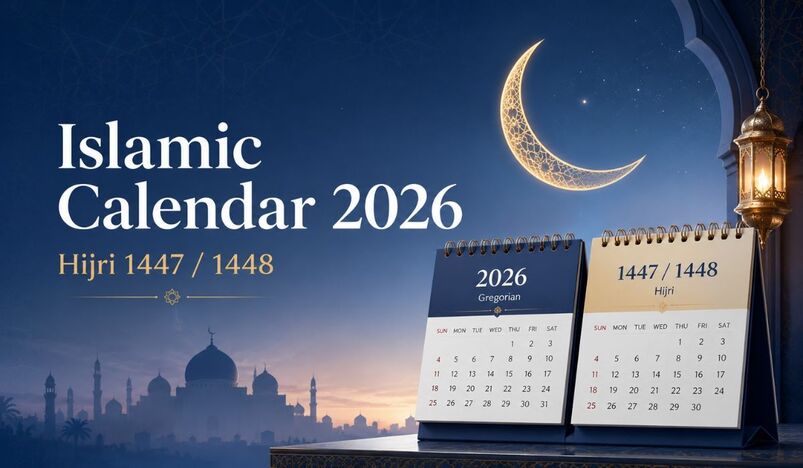
If you've been searching for a reliable, easy-to-follow guide on the Islamic Calendar 2026 — also known as the Hijri Calendar 1447/1448 — you're in the right place. Whether you need it for planning Ramadan, Eid celebrations, Hajj, or simply tracking Islamic months alongside the Gregorian calendar, this article gives you everything in one clear place.
What Is the Islamic Calendar?
The Islamic calendar — called the Hijri calendar (التقويم الهجري) — is a purely lunar calendar. It follows the cycles of the moon, meaning each month begins with the sighting of the new crescent moon. Unlike the Gregorian calendar that most of the world uses for daily life, the Hijri calendar has 12 lunar months totaling either 354 or 355 days per year.
This makes the Islamic year roughly 10 to 11 days shorter than the solar Gregorian year. As a result, Islamic events like Ramadan and Eid shift earlier each year relative to the Gregorian calendar — cycling through all seasons over roughly 33 years.
The calendar began counting from the Hijra — the Prophet Muhammad's migration from Mecca to Medina in 622 CE. That year became year 1 AH (Anno Hegirae).
Islamic Calendar 2026 vs. Hijri Calendar 1447/1448 — What's the Difference?
Here's the key thing to understand: 2026 (Gregorian) overlaps with two Hijri years — 1447 AH and 1448 AH. This is simply because the two calendars don't align on a January-to-January basis.
| Gregorian Period | Hijri Year |
| January 2026 – June 2026 | 1447 AH (last months) |
| July 2026 – December 2026 | 1448 AH (first months) |
So when you see "Islamic Calendar 2026 – Hijri 1447/1448," it just means the full Gregorian year of 2026 spans parts of both Hijri years. This is completely normal and happens every year.
The 12 Islamic Months — Names and Meaning
Every Muslim should know the names of the Hijri months. Here they are, in order, along with their significance:
- Muharram (محرم) — The first month and one of the four sacred months in Islam. The Day of Ashura falls on the 10th.
- Safar (صفر) — The second month. Historically a month of travel.
- Rabi al-Awwal (ربيع الأول) — The birth month of the Prophet Muhammad (ﷺ). Mawlid al-Nabi is observed on the 12th.
- Rabi al-Thani (ربيع الثاني) — Also called Rabi al-Akhir. A quieter month with no major observances.
- Jumada al-Awwal (جمادى الأولى) — The fifth month. Its name relates to the Arabic word for "dry" or "parched."
- Jumada al-Thani (جمادى الآخرة) — Also known as Jumada al-Akhirah. The sixth month.
- Rajab (رجب) — One of the four sacred months. Isra wal Miraj (Night Journey) falls in this month.
- Sha'ban (شعبان) — The month before Ramadan. Muslims often increase worship and fast voluntarily. Shab-e-Barat falls on the 15th.
- Ramadan (رمضان) — The holiest month of the Islamic year. Fasting is obligatory for all adult Muslims. Laylat al-Qadr (Night of Power) falls in the last 10 nights.
- Shawwal (شوال) — Eid al-Fitr is celebrated on the 1st. Fasting six days in this month carries special reward.
- Dhul Qadah (ذو القعدة) — Another sacred month. Pilgrims begin gathering for Hajj.
- Dhul Hijjah (ذو الحجة) — The month of Hajj. Eid al-Adha falls on the 10th. The first 10 days are among the most virtuous days of the year.
Key Islamic Dates in 2026 (Hijri 1447/1448)
Below are the major Islamic observances and holidays expected in 2026. Note that exact dates depend on moon sighting and may vary by one or two days depending on your country or local authority.
| Islamic Event | Expected Gregorian Date (2026) | Hijri Date |
| Isra Wal Miraj | Around January 27, 2026 | 27 Rajab 1447 |
| Shab-e-Barat | Around February 11–12, 2026 | 15 Sha'ban 1447 |
| Start of Ramadan | Around February 18–19, 2026 | 1 Ramadan 1447 |
| Laylat al-Qadr | Around March 15–20, 2026 | Last 10 nights of Ramadan |
| Eid al-Fitr | Around March 20–21, 2026 | 1 Shawwal 1447 |
| Arafat Day | Around May 26, 2026 | 9 Dhul Hijjah 1447 |
| Eid al-Adha | Around May 27, 2026 | 10 Dhul Hijjah 1447 |
| Islamic New Year (1448 AH) | Around June 16–17, 2026 | 1 Muharram 1448 |
| Day of Ashura | Around June 25–26, 2026 | 10 Muharram 1448 |
| Mawlid al-Nabi | Around September 4, 2026 | 12 Rabi al-Awwal 1448 |
Ramadan 2026 — What You Need to Know
Ramadan 2026 is expected to begin around February 18 or 19, 2026, making it a winter-to-early-spring fast in the Northern Hemisphere. This is great news for Muslims in colder regions — fasting hours will be shorter compared to summer Ramadans.
Key facts about Ramadan 2026:
- Expected duration: 29 or 30 days (confirmed by moon sighting)
- Fasting hours will vary significantly by location — shorter near the equator, longer in northern Europe and Canada
- Laylat al-Qadr is sought in the odd nights of the last 10 days (21st, 23rd, 25th, 27th, 29th of Ramadan)
- Eid al-Fitr 2026 is expected around March 20–21, 2026
Eid al-Adha 2026 — Hajj Season
Eid al-Adha 2026 falls around May 27, 2026. The Day of Arafat — the holiest day of the Hajj pilgrimage and also a day of significant fasting for non-pilgrims — is expected around May 26, 2026.
Fasting on the Day of Arafat is a Sunnah (prophetic tradition) for Muslims who are not performing Hajj. The Prophet (ﷺ) said it expiates the sins of the past year and the coming year.
The first 10 days of Dhul Hijjah leading up to Eid al-Adha are also among the most virtuous days in the Islamic year — even more so than the last 10 nights of Ramadan, according to some scholars.
Muharram and Ashura 2026
The Islamic New Year 1448 AH begins around June 16–17, 2026. Unlike New Year celebrations in the Gregorian calendar, the Islamic New Year is a time of reflection and gratitude, not public festivity.
The Day of Ashura (10 Muharram) falls around June 25–26, 2026. Fasting on this day is recommended. The Prophet (ﷺ) said it expiates the sins of the previous year. Muslims may also fast the 9th alongside the 10th to distinguish the Islamic practice from that of other communities.
How to Use the Islamic Calendar Alongside the Gregorian Calendar
Many Muslims live in countries that primarily use the Gregorian calendar at work, in schools, and in government — while Islamic religious life follows the Hijri calendar. Here are a few practical tips:
- Use a dual calendar app — Many Islamic calendar apps show both Gregorian and Hijri dates side by side. Look for apps from your local Islamic authority or a trusted global source.
- Convert dates accurately — Online Hijri-to-Gregorian converters can help, but always verify moon sighting announcements before relying on calculated dates for Ramadan or Eid.
- Plan ahead for leave — If your workplace requires advance notice for religious holidays, use the estimated dates above to plan your time off for Ramadan, Eid al-Fitr, and Eid al-Adha well in advance.
- Keep Friday in mind — Friday (Jumu'ah) holds special significance in Islam every week, independent of the Hijri month or date.
Frequently Asked Questions (FAQs)
Q: What Hijri year is 2026?
The Gregorian year 2026 corresponds to Hijri years 1447 AH (until approximately June 2026) and 1448 AH (from approximately June/July 2026 onwards).
Q: When does Ramadan start in 2026?
Ramadan 2026 is expected to begin around February 18 or 19, 2026, subject to moon sighting in your region.
Q: When is Eid al-Fitr 2026?
Eid al-Fitr 2026 is expected around March 20–21, 2026 — marking the end of Ramadan 1447 AH.
Q: When is Eid al-Adha 2026?
Eid al-Adha 2026 is expected around May 27, 2026 — the 10th of Dhul Hijjah 1447 AH.
Q: How many days are in the Islamic year 2026?
A Hijri year is either 354 or 355 days, depending on whether it's a common or leap year. Since 2026 spans parts of two Hijri years, the total days covered is still 365 (a full Gregorian year).
Q: Is the Islamic calendar the same everywhere?
The structure is the same globally, but the start of each month can vary by a day or two depending on whether countries rely on local moon sighting, global moon sighting, or astronomical calculation.
Q: What are the four sacred months in Islam?
The four sacred months (Al-Ashhur al-Hurum) are Muharram, Rajab, Dhul Qadah, and Dhul Hijjah. Warfare was traditionally forbidden in these months, and they carry additional spiritual weight.
Q: Why does Ramadan fall earlier each year?
Because the Islamic lunar year is about 10–11 days shorter than the Gregorian solar year, all Islamic dates — including Ramadan — shift approximately 10 days earlier each Gregorian year. Ramadan cycles through all seasons over about 33 years.
Final Thoughts
The Islamic Calendar 2026 (Hijri 1447/1448) is a year packed with meaningful dates — from the fasting of Ramadan and the joy of Eid, to the spiritual heights of Hajj season and the reflective beginning of a new Hijri year. Understanding the Hijri calendar is more than a scheduling tool — it's a way of staying connected to the rhythm of Islamic worship throughout the year.
Whether you're a student, a working professional, a parent planning your family's Islamic observances, or someone simply curious about how the Hijri calendar works — keeping these dates in mind helps you prepare, plan, and make the most of every sacred moment the Islamic year has to offer.
.jpg)
.jpg)
.jpg)
.jpg)


.jpg)
.jpg)


.jpg)


.jpg)
.png)
.jpg)











Leave a comment