


 By Admin - May 26, 2026
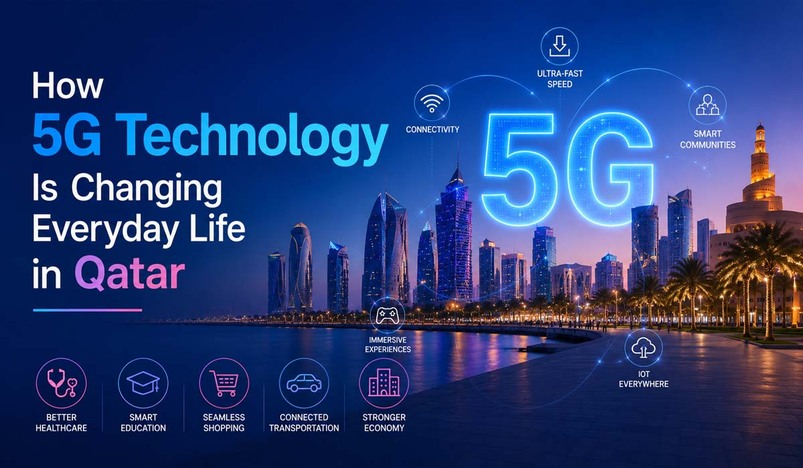
Qatar has the distinction of being the first country in the world to launch a nationwide 5G network — and in 2026, that early bet on connectivity is paying off in ways that touch almost every aspect of daily life. From the way residents commute and receive healthcare, to how students learn and businesses operate, 5G is no longer just a telecom milestone. It is quietly reshaping Qatar from the inside out.
Qatar's two major operators — Ooredoo and Vodafone Qatar — have both invested heavily to make these figures a reality. In 2025, Vodafone Qatar verified 6 GHz spectrum with 128 T/R massive MIMO technology, achieving over 10 Gbps user speeds in trials. Meanwhile, Ooredoo has been rolling out 5G Standalone architecture, which delivers lower latency and a stronger foundation for the next wave of applications including smart hospitals and autonomous systems.
Smart cities: Lusail and Msheireb lead the way
Perhaps nowhere is 5G's impact more visible than in Qatar's smart city projects. Lusail — the gleaming planned city north of Doha built to house 450,000 people — integrates 5G-connected IoT sensors and real-time data systems to manage everything from utilities and waste to traffic flow and public safety. Msheireb Downtown Doha, the world's first smart sustainable downtown regeneration project, relies on 5G edge nodes and NB-IoT infrastructure to run its interconnected building systems.
"5G Standalone provides faster internet, lower delays, and a strong base for future innovations such as smart hospitals, smart factories, self-driving cars, better learning tools, and smarter ports." — Sheikh Ali bin Jabor Al-Thani, CEO, Ooredoo Qatar
Healthcare, education and daily life
Digital healthcare
5G-enabled telemedicine, remote diagnostics, and connected medical devices are transforming how Qataris access care. Ooredoo's Oracle Alloy sovereign cloud platform — live in Qatar since late 2025 — supports real-time medical data processing aligned with Vision 2030's smart hospital ambitions.
Education and digital literacy
Ooredoo partnered with Qatar's Ministry of Education as the official telecom sponsor of the 2025–2026 Back to School initiative, equipping students and educators with digital tools powered by 5G connectivity. Education City's dense campus environment is one of the highest-demand zones for 5G edge computing in the country.
Business and industrial IoT
In April 2026, Ooredoo launched a new LTE-M network to support large-scale IoT applications, from smart utility management to industrial automation. The operator's industrial eSIM solution, launched in late 2025, enables businesses to manage connected devices across multiple networks seamlessly.
Entertainment and everyday connectivity
Median 5G speeds exceeding 300 Mbps now support UHD streaming, cloud gaming, and enterprise VPNs as everyday experiences. Vodafone's mmWave trials point to future capabilities including 360-degree 8K video streaming at major events — a capability that will cement Qatar's position as a global entertainment and sports destination.
What comes next: 6G on the horizon
National 6G Testbed launched — November 2025
Qatar launched a national 6G testbed platform at MWC Doha 2025, with the CRA, Ooredoo and Vodafone collaborating to fast-track AI-native networks, edge computing, and IoT trials.
Updated National Frequency Plan — February 2026
Qatar's CRA issued a revised national spectrum allocation plan aligning the country with international 5G and next-generation wireless standards, supporting the Qatar Digital Agenda 2030.
Qatar Center for Quantum Computing (QC2) — active
Hamad Bin Khalifa University's QC2 is partnered with Quantinuum and NASA to push the boundaries of quantum computing and 6G-enabling technologies, positioning Qatar at the cutting edge of what comes after 5G.
Qatar has already been designated a World Economic Forum Advanced Manufacturing Hub, with its 5G and digital infrastructure underpinning ambitions in medtech, smart manufacturing, and sustainable urban development under Vision 2030.
For residents and visitors alike, the effects of 5G are increasingly felt in small but meaningful ways — faster government app responses, seamless navigation through Lusail's smart streets, instant connectivity at Hamad International Airport, and healthcare appointments handled entirely through a phone. Qatar's 5G story is not just about speed. It is about a country that made a deliberate choice to build its future on connectivity — and is now beginning to live in it.
.jpg)


.jpg)

.jpg)
.jpg)
.jpg)
.jpg)


.jpg)
.jpg)



.jpg)


.jpg)
.png)
.jpg)













Leave a comment