


 By admin - May 08, 2026
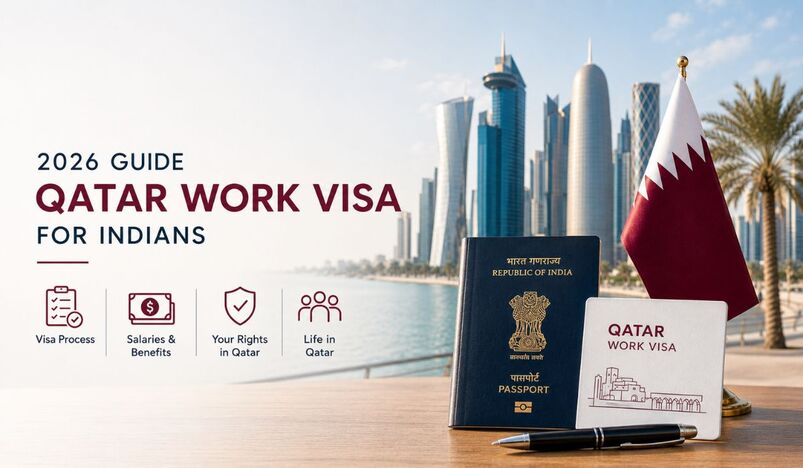
Updated May 2026. Real talk on process, salaries, rights, and whether it is actually worth it.
So You Want to Work in Qatar. Let's Be Honest About It.
Somebody at your office came back from Doha last Diwali, bought a new car in cash, and suddenly everyone is asking — how do you get to Qatar? It happens constantly. The Gulf dream, especially Qatar, has a very specific pull on Indian professionals, and in 2026, that pull is stronger than it has been in years.
But let us have an actual conversation about this, not just the highlight reel. Yes, the salaries are genuinely high. Yes, there is no income tax. And yes, you can save money there at a rate that is almost impossible to match in India at most salary levels. But the process is not automatic, the paperwork is real, and if you go in without knowing what you are getting into, it can get messy fast.
This guide is for Indian professionals who are seriously considering Qatar — not as a dream, but as a concrete next step. We will cover the visa process, the documents, what the jobs actually pay, what life costs, and the things most guides quietly skip over.
Why Qatar, Specifically? And Why 2026 Is a Good Time
There are seven Gulf countries. Why are so many Indians choosing Qatar over Dubai or Riyadh?
Qatar is smaller and, in a strange way, more manageable. Doha is a compact city. You can get from one end to the other in 30 minutes on most days. The chaos of a mega-city is largely absent. If you are coming from a Tier-2 Indian city, the transition is actually quite gentle.
Qatar's economy went through a visible transformation after the 2022 FIFA World Cup. Stadiums, hotels, roads, tech infrastructure, public transit — billions were spent in a short window. That spending did not stop when the tournament ended. The government doubled down on Vision 2030, Qatar's long-term plan to reduce dependence on oil and build out healthcare, education, technology, and tourism. All of that means jobs — specifically jobs that need skills in short supply locally.
The 2025 India–Qatar Strategic Partnership formalised what has been an informal reality for decades. India is one of Qatar's biggest trade partners. More than 830,000 Indians live and work in Qatar. That is not a small number for a country of barely 3 million people total. The partnership has fast-tracked mutual recognition of Indian qualifications and added diplomatic weight to worker welfare commitments.
And then there is the money. A software developer earning INR 18 lakhs in India can realistically earn QAR 18,000 to 25,000 per month in Qatar — roughly INR 50 to 68 lakhs annually, tax-free, often with housing and travel included. That differential is hard to ignore.
One number worth knowing: QAR 1 equals approximately INR 22 to 23 as of early 2026. Run your current Indian salary through that conversion and you will quickly understand why Qatar gets this much attention.
Types of Qatar Work Visas — Which One Actually Applies to You
There are multiple visa categories and people mix them up constantly.
The Employment Visa is what most people mean when they say Qatar work visa. It is long-term, renewable, and comes with full employer benefits. This is what the vast majority of Indian professionals hold and what this guide focuses on.
The Business Visa is for meetings, negotiations, or training trips only. You cannot legally earn a salary on this. And yes, people do get caught trying.
The Temporary Work Visa is project-based, usually 1 to 6 months. Common in construction and oil and gas for specialist roles brought in for a specific contract.
The Family Residence Visa is not a work visa, but it is relevant because it lets you sponsor your spouse and children once you have a QID and meet the income requirement.
The Freelance or Project Visa is tied to a specific contract's duration. Used mostly in IT consulting and construction.
For the vast majority of Indian professionals reading this, the Employment Visa is what applies.
The Qatar Work Visa Process — What Actually Happens and When
The single most important thing to understand: you do not apply for a Qatar work visa yourself. Your employer does. The entire process is employer-driven. If someone is asking you to independently apply for a visa or pay fees for a Qatar work permit, stop. That is not how the legitimate process works.
Step 1 — Get a Job Offer. Everything Starts Here.
Qatar does not have a walk-in work visa or a job seeker visa you can show up on. Your future employer has to initiate everything. Most Indians find roles through Naukri Gulf, LinkedIn, Bayt.com, or through someone they already know in Doha. The Indian professional community there is tight-knit and referrals genuinely work. Once you have a written offer, keep it safe. You will need it at multiple stages.
Step 2 — Your Employer Applies for the Work Permit, Not You.
Your company's PRO, which stands for Public Relations Officer, submits the work permit application to the Ministry of Labour. Your job at this stage is to send them your documents — passport, educational certificates, experience letters. Processing typically takes 2 to 4 weeks. If it drags past 6 weeks, a gentle follow-up is reasonable.
Step 3 — Medical Test in India at GAMCA-Approved Centres Only.
Once the work permit is approved, you need a medical fitness certificate from a GAMCA-approved centre. This is not optional and you cannot get it from just any clinic. The test checks for tuberculosis, hepatitis B, HIV, and a few other conditions. Results come in about a week. The list of approved centres is on the GCC Approved Medical Centres Association website. Check before booking.
Step 4 — Visa Stamping at the Qatar Embassy.
Your employer sends you a visa approval notification. You take this to the Qatar Embassy in New Delhi or the Consulate in Mumbai for stamping on your passport. This is typically a same-day or next-day service.
Step 5 — Arrive in Qatar, Do Another Medical, Get Your QID.
Yes, there is a second medical test after you land. This one is at a government-designated health centre in Doha and your employer arranges it. Within 2 to 4 weeks of landing, you submit biometrics and receive your Qatar ID, known as the QID. The QID is essentially your life in Qatar. You need it to rent an apartment, open a bank account, buy a SIM card, and drive a car. Treat it like your Aadhaar card, but even more critical.
Step 6 — Changing Employers Later.
Pre-2020, changing employers in Qatar without an NOC from your current boss was nearly impossible. The 2021 labour reforms changed this. After 12 months of service, you can apply to the Ministry of Labour to transfer to a new employer without your old employer's permission. The process takes time and paperwork but it is a real option and many Indians have used it.
Rough timeline from start to finish: Work permit approval takes 2 to 4 weeks. Visa stamping at the embassy takes 1 to 2 days. GAMCA medical in India takes about a week. After landing, the QID arrives within 2 to 4 weeks. The total from offer letter to legal residency is usually 6 to 10 weeks.
Documents You Need — And the Attestation Part Nobody Tells You About Early Enough
This is where most delays happen. Not at the embassy, not at the Ministry of Labour. At the attestation stage. People receive their offer letter, spend two weeks celebrating, and then realise their degree certificates are not attested. By then they are already behind.
From your side you need a valid Indian passport with minimum 6 months validity beyond your planned stay, educational certificates attested by the relevant state authority then the Ministry of External Affairs then the Qatar Embassy, experience letters from previous employers on company letterhead, a GAMCA medical fitness certificate from an approved centre only, passport-size photos on a white background, and a Police Clearance Certificate from your local police station or via the Passport Seva portal.
From your employer's side they arrange the work permit approval from the Qatar Ministry of Labour, the employment contract in both Arabic and English, and the visa approval notification from the General Directorate of Passports.
The attestation chain goes in this order: state authority, then the Ministry of External Affairs in New Delhi, then the Qatar Embassy in India. This process takes 3 to 6 weeks, sometimes longer depending on your state. Maharashtra, UP, Delhi, Tamil Nadu, and Kerala each have their own process and timelines. Start attestation the day you receive your offer letter. Do not wait.
Top Jobs in Qatar for Indians in 2026 — Roles and Real Salaries
Qatar's job market in 2026 is not just oil and gas. That was true twenty years ago. Today you will find Indians working in banking, healthcare, IT, legal firms, marketing agencies, hospitality management, and universities. The variety is real.
Nevertheless, the top earnings do remain heavily concentrated in energy, engineering and specialised medicine. Below are realistic monthly salaries, QAR
Petroleum and LNG Engineers QAR 25,000 to 40,000/mo. Cloud Solutions Architect :QAR 35,000 to QAR 45,000 Doctors & Specialist Surgeons: QAR 40,000 to 60,000 Full-stack Software Developers: QAR 20,000 to 35,000 Cyber Security Specialists: QAR 25,000 average – QAR 40,000 Because Civil and Structural Engineers get QAR 15,000 to 25,000. QAR 20,000-35,000 Financial Analyst & Digital Marketing Manager earns QAR 8000 to 15,000.
These are base salary figures only. Most employers add housing allowance, transport, and insurance on top, which typically increases total compensation by 20 to 35 percent. Most employers also prefer professionals with 3 to 5 years of experience minimum.
Indians are finding jobs through Naukri Gulf, LinkedIn with location set to Qatar or Gulf, Bayt.com, direct applications to QatarEnergy, Hamad Medical Corporation, Qatar Airways, and Ooredoo, and through internal referrals from Indians already working there. That last channel is probably the most effective one.
What Your Qatar Package Actually Looks Like Beyond the Salary Number
Indian professionals negotiating Qatar packages often fixate on the base salary and miss how the full package works. The total compensation picture is often dramatically better than the monthly salary number alone suggests.
Most employers provide housing, either company-provided accommodation or a monthly housing allowance of QAR 2,000 to 6,000. They also provide transport through a company vehicle, fuel card, or monthly allowance of QAR 500 to 1,500. Medical insurance is typically comprehensive for you and sometimes extended to family. Annual flight tickets to India are standard, usually one return ticket per year with senior roles often getting two. End-of-service gratuity pays you one month's basic salary for every year of service as a lump sum when you leave Qatar. Someone who serves 7 years walks away with 7 months' salary in their hand. Annual paid leave is a minimum of 21 days under Qatar Labour Law.
The combination of no income tax, free or subsidised housing, and covered medical means your actual savings rate in Qatar can reach 50 to 70 percent of your base salary. That is almost impossible to match at equivalent seniority levels in India.
Cost of Living in Qatar — What You Actually Spend Every Month
Doha is not cheap. Let us get that out of the way. But it is not London or Singapore either. The key variable is housing. If your employer covers it, your monthly expenses drop dramatically.
Rent for a shared 1BHK apartment runs QAR 1,500 to 2,500. Your own 2BHK costs QAR 3,500 to 6,000. Groceries run about QAR 600 to 1,200. Transport by metro, taxi, or fuel costs QAR 400 to 900. Utilities including power, water, and internet cost QAR 350 to 650. Eating out costs QAR 400 to 800. School fees per child run QAR 2,000 to 5,000 depending on the school.
A mid-level professional earning QAR 12,000 per month with employer-provided housing can realistically save QAR 7,000 to 9,000 per month after all expenses. Over 12 months that is roughly INR 19 to 25 lakhs in savings. Over three years you can see why people make the move.
One genuinely pleasant surprise for Indian families: Indian groceries are widely available in Doha and not significantly more expensive than in major Indian metros. Lentils, rice, Indian spices, frozen parathas, paneer — you can find most things at LuLu Hypermarket. You are not eating expensive imported food to maintain an Indian diet.
Your Rights as an Indian Worker in Qatar — Read This Before You Go
This section matters more than the salary table and people skip it far too often.
Qatar's labour laws have changed significantly since 2020. The old kafala system where you were tied to your employer and could not leave the country without their permission has been substantially reformed. It has not disappeared completely but the worst parts no longer apply to most workers.
You no longer need an exit permit to leave Qatar. You can leave without your employer's approval. This was not the case before 2020.
After 12 months of continuous service, you can change employers without a No Objection Certificate from your current employer. Apply through the Ministry of Labour portal.
Qatar's minimum wage is QAR 1,000 per month, plus QAR 300 food allowance and QAR 200 housing allowance if not provided by the employer directly. Skilled professionals earn far above this but the floor exists.
Employers must pay salaries through the Wage Protection System, a monitored digital platform. If your salary is late, the system flags it automatically.
The Worker Support Fund is a government-backed scheme that steps in to compensate employees if their employer goes bankrupt or refuses to pay. It is not perfect but it has paid out real claims.
If you face a labour dispute over unpaid wages, contract violations, or wrongful termination, the Ministry of Labour has an online dispute resolution system and a hotline at 17008007. Hindi is one of the available languages. Use these channels rather than staying silent.
Always keep a personal copy of your employment contract in both Arabic and English. Photograph your QID and keep digital copies in cloud storage. If your employer asks you to sign Arabic documents you have not translated, do not sign until you understand them. That is your legal right.
The India–Qatar Strategic Partnership — What It Actually Changes for Indian Workers
In early 2025, India and Qatar formally elevated their relationship to a Strategic Partnership. Behind the diplomatic language, a few things actually matter for Indian professionals on the ground.
Both governments committed to recognising Indian degrees in medicine, nursing, and engineering without the lengthy foreign equivalency process that previously added months to professional licensing. This is the most practically useful change.
Formal mechanisms for resolving Indian worker complaints faster have been established, along with additional oversight of Indian recruitment agencies operating in the Gulf.
As more joint ventures and Indian companies set up operations in Qatar to capture the growing bilateral trade, demand grows specifically for India-based management, finance, and IT talent to staff those operations.
India's UPI payment system now works at several merchant locations in Doha, and cross-border remittance frameworks are being streamlined, reducing fees when sending money home. The practical effects will unfold over years not months, but the qualification recognition piece and faster dispute resolution are already making a difference for Indian professionals in 2026.
Bringing Your Family to Qatar — Is It Worth It?
A lot of people go to Qatar alone for the first year, send money home, and then decide whether to bring the family. That is a completely valid approach. Many families do relocate together, and Doha is a reasonably good place for an Indian family — more so than people expect.
Indian schooling options in Doha include DPS Modern Indian School, The Indian School Doha, and Indian Community School Doha, all offering CBSE curriculum. Several international schools also cater to Indian students well. Fees range from QAR 2,000 to 5,000 per month per child depending on the school. If you have two or more school-age children, factor this into your savings calculation carefully before deciding to bring everyone along.
To sponsor your family you need a valid QID, monthly earnings above QAR 4,000 to 6,000, an application through the Ministry of Interior portal, and evidence of medical insurance coverage for your family members.
Mistakes Indians Make Before and After Moving to Qatar
These come up repeatedly and most of them are completely avoidable.
Waiting too long to start document attestation is the most common mistake. Start the day you receive your offer letter. Attestation alone takes 3 to 6 weeks, sometimes longer. This is the single biggest cause of delayed start dates.
Accepting a verbal offer without a written contract is a serious risk. Everything must be in writing. If an employer is reluctant to provide a written contract before you travel, that is not a negotiating tactic — it is a red flag.
Not verifying the employer is another costly mistake. Check your Qatari employer on the Qatar Ministry of Commerce and Industry database online. Fake job offers targeting Indians exist. If someone is asking you to pay for your visa or recruitment, that is illegal under Qatar law and almost certainly a scam.
Working on a business or tourist visa is illegal in Qatar and results in deportation and a re-entry ban. Some people try to enter on a business visa and look for work once there. Do not do this.
Not reading the employment contract carefully is a mistake that haunts people later. The Arabic version is the legally binding one in a Qatar court. Get a certified translator to review it before you sign if you cannot read Arabic.
Assuming your gross salary equals your savings is a miscalculation. Run your actual budget including rent, food, transport, occasional flights home, and money sent to parents. Your net savings will be lower than the raw salary suggests but still likely far higher than comparable roles in India.
Questions Indians Actually Ask Before Moving to Qatar
Q: Can I apply for a Qatar work visa without a job offer?
No. There is no walk-in or job-seeker visa for Qatar. Your employer sponsors everything. Without a confirmed offer from a Qatari company, the process does not start.
Q: How long does the whole thing take, realistically?
Between 6 and 10 weeks from offer letter to QID, assuming no document delays. The main bottleneck is almost always attestation in India, which people start too late.
Q: Who pays for the visa, me or my employer?
Your employer, legally. Qatar law prohibits employers from passing visa or recruitment costs to employees. If someone is asking you to pay, walk away.
Q: Can I bring my family?
Yes, once you have a QID and earn above QAR 4,000 to 6,000 per month. Many Indian families live comfortably in Doha with access to Indian schools, temples, and grocery stores.
Q: Is income earned in Qatar taxed in India?
Indian residents who spend more than 182 days abroad in a financial year become NRIs. NRI salary income from a foreign employer is generally not taxable in India. Consult a CA for your specific situation.
Q: What happens if my employer does not pay me?
Qatar's Worker Support Fund compensates employees when companies fail to pay wages. The Wage Protection System monitors employer payments digitally. These systems are imperfect but they exist and have helped real workers recover their dues.
Q: Can I switch jobs after arriving?
Yes, after 12 months of service, without needing your employer's NOC. Apply through the Ministry of Labour portal.
Q: Are Indian degrees recognised in Qatar?
Generally yes, though some fields require additional verification. The 2025 Strategic Partnership has specifically fast-tracked recognition in medicine, engineering, and nursing.
Final Checklist Before You Book Your Ticket
Written employment contract received and reviewed in both Arabic and English. Employer verified on Qatar Ministry of Commerce database. Passport valid for at least 6 months beyond intended stay. Attestation process started, meaning state authority then MEA then Qatar Embassy. GAMCA medical appointment booked at an approved centre. Police Clearance Certificate applied for. Family situation assessed including schooling costs if children are coming. Digital copies of all documents saved in cloud storage.
So — Is Qatar Worth It in 2026?
Probably the most honest answer is: it depends on where you are in your career and life, and what you are optimising for.
If you are a skilled professional between 28 and 45, working in a field that Qatar actually needs — engineering, healthcare, IT, finance, energy — and you have the flexibility to relocate for two to five years, Qatar in 2026 makes strong financial sense. The visa process is manageable if you prepare for it. The living conditions are genuinely good. The Indian community makes the cultural adjustment easier than it sounds on paper. And the savings you accumulate in three to five years can meaningfully change your financial position back home.
If you have strong family ties that make long periods away complicated, if you are early-career without much experience, or if you are looking for a country where you can eventually settle permanently, Qatar is probably not the right destination. It is not a path to citizenship. Most people go for a defined period and return.
But for the person this guide is written for — someone who has done their research, has a real offer on the table, and wants to understand exactly what they are getting into — Qatar is a legitimate, well-trodden path that hundreds of thousands of Indians have walked before you. With the right preparation, it is less of a leap into the unknown and more of a calculated, high-return move.
Get your documents attested early. Verify your employer. Read your contract. And call your family regularly — the chai tastes different in Doha, but the conversations still matter.

_20-08-2026_05-08.jpg)
_27-51-2026_11-51.png)
_27-43-2026_12-43.png)



.jpg)
.jpg)




.jpg)


.jpg)
.png)
.jpg)













Leave a comment