

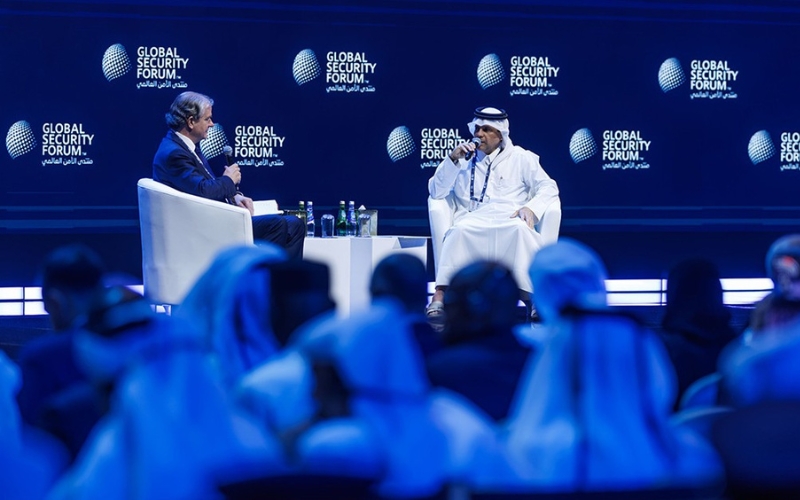
Doha, October 20, 2026 : HE Deputy Prime Minister and Minister of State for Defense Affairs Sheikh Saoud bin Abdulrahman bin Hassan bin Ali Al-Thani has reaffirmed Qatar’s commitment to enhancing its defense capabilities while continuing to promote mediation and dialogue to support regional stability.
Speaking during a panel discussion on the opening day of the eighth Global Security Forum in Doha, he described Gulf security as essential to global economic stability and the uninterrupted flow of international supply chains.
He identified three major challenges Qatar had faced in recent months: attacks on its territory, disruptions to energy supplies, and the wider consequences of regional conflicts. He warned that interruptions to Gulf energy supplies could affect not only energy markets but also international investment, global supply chains and the assistance Gulf countries provide worldwide.
The Deputy Prime Minister stressed that developments in the region have direct implications for the global economy. He said Qatar had taken steps to protect its assets and strengthen its defense readiness in cooperation with allies, demonstrating its capacity to defend its territory. He added that Gulf countries had developed valuable experience in navigating crises by diversifying their economies and expanding international partnerships.
Outlining Qatar’s defense priorities, Sheikh Saoud said the country had identified three key areas for further development: air defense; countering drones and electronic warfare, including cybersecurity; and building national capabilities through cooperation with regional and international partners.
He also announced that Qatar would soon unveil a new initiative with regional partners to develop capabilities in these fields. In addition, the country plans to establish a defense industries center to further strengthen its domestic defense sector.
He highlighted the strategic importance of Al Udeid Air Base, noting that its development continues to meet the requirements of the Qatari Armed Forces. The base also hosts US forces and representatives from more than 20 countries, reflecting Qatar’s extensive defense partnerships.
Addressing Qatar’s diplomatic approach, Sheikh Saoud emphasized that defense preparedness and mediation complement one another. He explained that Qatar’s mediation efforts are intended to prevent conflicts and do not diminish the importance of protecting national security and sovereignty.
He pointed to negotiations between the Democratic Republic of the Congo and Rwanda as an example of the patience required in mediation, noting that the process took several years to achieve tangible progress. He added that Qatar had continued its mediation efforts across various issues in coordination with its partners.
On regional relations, the Deputy Prime Minister called for comprehensive dialogue involving Gulf Cooperation Council countries, Pakistan and Türkiye, in consultation with international partners, to establish lasting peace with Iran. He said such dialogue should be grounded in trust, non-aggression and the consideration of mutual security concerns.
He also cited the post-war economic rapprochement between Germany and France as an example of how economic cooperation can help prevent future conflicts. He stressed that Iran remains a neighboring country and that the region needs effective mechanisms to avoid renewed tensions.
Regarding maritime security, Sheikh Saoud reaffirmed Qatar’s opposition to imposing transit fees in the Strait of Hormuz, saying the position was consistent with international law. He warned that uncertainty surrounding the strategic waterway could have negative consequences for energy markets and the global economy.
Despite differences with Iran, he said Qatar continued to maintain diplomatic communication channels with Tehran, expressing hope that existing understandings would help build trust and prevent further escalation.
Concluding his remarks, Sheikh Saoud reiterated Qatar’s commitment to maintaining defense readiness alongside its partners while continuing to pursue dialogue and mediation as pathways toward stronger economic ties, regional security and lasting stability.
Source: QNA