


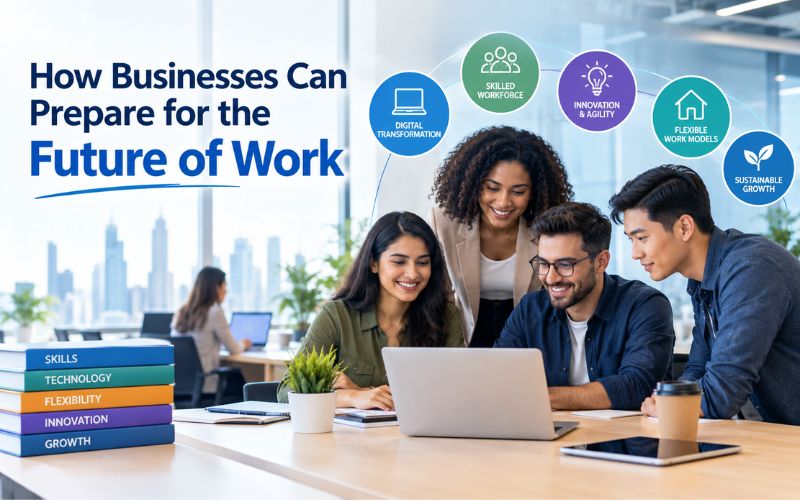
The way businesses operate is changing rapidly. Artificial intelligence, digital tools, evolving employee expectations, and new working practices are influencing how organisations hire people, manage teams, and develop professional skills. For companies in Dubai and across the UAE, preparing for these changes means investing in both technology and people.
The future of work is not simply about automating existing processes. It is about helping employees adapt, encouraging continuous learning, and using technology to solve real business challenges. Organisations that understand the relationship between human skills and digital innovation can make more informed decisions and prepare their teams for changing workplace demands.
So, how can businesses prepare for the future while maintaining productivity, employee engagement, and a positive working environment?
1. Understand How the Workplace Is Changing
Modern workplaces are becoming increasingly influenced by technology. Recruitment platforms, cloud-based collaboration tools, data analytics, and artificial intelligence are changing how employees complete tasks and share information.
For example, recruitment teams can use digital systems to organise applications, while managers can use workforce data to identify skill gaps and plan employee development. AI tools can also assist with summarising information, preparing routine documents, and supporting research.
However, technology alone cannot guarantee better results. Employees still need professional judgement, communication skills, and a clear understanding of business objectives.
Businesses should begin by reviewing their existing processes and identifying areas where new technology could provide practical benefits. Rather than adopting every available tool, they should focus on solutions that address genuine operational challenges.
2. Invest in Employee Training and Professional Development
Employee development is one of the most important parts of preparing for the future of work. As responsibilities change, workers need opportunities to develop new capabilities and strengthen their existing knowledge.
Professional training can help employees improve communication, leadership, recruitment, problem-solving, digital literacy, and people management. These skills remain valuable even as workplace technology becomes more advanced.
Human resources teams have a particularly important role in this process. They can assess workforce needs, identify suitable learning opportunities, and help managers create development plans that support both individual employees and organisational goals.
Professionals interested in strengthening their HR knowledge can explore the learning opportunities available through LIHRM HR Institute. Developing a stronger understanding of human resources can help aspiring and existing professionals learn more about employee management, recruitment, and workplace development.
Businesses should also encourage employees to apply what they learn in their daily responsibilities. Practical workshops, mentoring, and regular feedback can make professional development more useful than training that remains disconnected from actual workplace challenges.
3. Explore Artificial Intelligence and Its Business Applications
Artificial intelligence is becoming an important consideration for businesses across different industries. Depending on the task, AI tools can help employees process information, identify patterns, prepare drafts, and reduce repetitive administrative work.
For example, a marketing team might use AI to organise research, while an operations department could investigate whether automation can simplify routine reporting. HR teams may also use selected tools to support workforce planning and administrative activities.
Understanding AI is therefore becoming useful for professionals who want to remain adaptable in a technology-driven environment.
Individuals and organisations interested in learning more about artificial intelligence can explore LISRC AI Education. Building awareness of AI concepts and their practical applications can help learners better understand how emerging technologies may influence business operations and professional responsibilities.
Nevertheless, AI should be introduced thoughtfully. Businesses need to consider data privacy, information security, accuracy, cost, and employee readiness before implementing new systems.
AI-generated information should also be reviewed by people who understand the relevant subject. This is especially important when technology influences recruitment, performance assessment, customer communication, or other decisions with significant consequences.
4. Bring Human Resources and AI Together
Human resources and artificial intelligence can complement one another when businesses introduce technology with clear objectives.
HR professionals understand employee needs, organisational culture, recruitment requirements, and workplace relationships. AI tools can assist with selected administrative tasks and information processing, allowing professionals to devote more attention to responsibilities that require human judgement.
Consider a company that wants to improve its recruitment process. An AI-supported system might help organise applications or identify relevant information within CVs. However, HR professionals still need to assess candidates fairly, evaluate their experience, conduct interviews, and make informed hiring decisions.
The same principle applies to employee development. Digital learning platforms can help organisations identify potential training needs, but managers should still consider employees' career goals, existing capabilities, and individual circumstances.
A balanced approach allows businesses to benefit from technological innovation without overlooking the human side of work. It also encourages cooperation between HR teams, technology specialists, managers, and employees.
5. Develop Digital Skills Across the Organisation
Digital transformation is more effective when employees understand how to use the tools available to them. Introducing new software without adequate guidance can create confusion, inconsistent results, and unnecessary resistance.
Businesses should first assess the current digital capabilities of their workforce. Some employees may need support with basic workplace software, while others may benefit from more advanced training in data analysis, automation, or AI applications.
A practical digital skills programme can cover:
-
Using workplace software and collaboration platforms effectively.
-
Understanding basic data analysis and interpretation.
-
Using AI tools responsibly and checking their outputs.
-
Protecting confidential business and employee information.
-
Recognising tasks that may benefit from automation.
-
Communicating effectively in digital and hybrid workplaces.
Training should also explain the limitations of technology. Employees need to know when information should be verified, when confidential data must not be shared, and when a decision requires human review.
Developing digital confidence across departments can help businesses introduce new systems more smoothly and make better use of their technology investments.
6. Prepare Managers for Changing Workplace Responsibilities
Managers play a central role in helping employees adapt to change. Their responsibilities increasingly involve guiding teams through new processes, supporting professional development, and maintaining effective communication.
When introducing an AI tool or a new digital workflow, managers should explain why the change is necessary and how it may affect daily responsibilities. Employees should have an opportunity to ask questions, receive training, and share feedback.
Leadership development should therefore include change management, critical thinking, communication, ethical decision-making, and digital awareness.
Managers should also avoid measuring success solely by the number of technologies introduced. Instead, they should assess whether new systems improve work quality, reduce unnecessary effort, or help employees serve customers more effectively.
Strong leadership can make the difference between a technology initiative that creates confusion and one that delivers meaningful improvements.
7. Encourage Continuous Learning
The skills required in the workplace will continue to evolve. For this reason, businesses should treat learning as an ongoing process rather than an activity that takes place only during onboarding or annual training sessions.
A culture of continuous learning encourages employees to ask questions, share knowledge, explore new responsibilities, and improve their capabilities over time.
Employers can support this culture through mentoring, internal workshops, professional courses, knowledge-sharing sessions, and regular career discussions.
Employees also benefit when training is connected to real opportunities. For example, a worker who learns a new data tool should have an opportunity to use it in a relevant project. Similarly, an employee who develops leadership skills may benefit from taking responsibility for a small team initiative.
Continuous learning helps organisations build internal capabilities instead of relying exclusively on external recruitment whenever new skills are required.
8. Make Employee Well-Being Part of Digital Transformation
Workplace transformation should consider employee well-being alongside productivity. Although new tools can simplify some tasks, they may also create uncertainty, introduce unfamiliar responsibilities, or increase concerns about monitoring and job security.
Businesses should communicate changes clearly and provide reasonable opportunities for employees to adapt. They should also listen to feedback, review workloads, and ensure that technology does not create unnecessary administrative pressure.
When AI is introduced, organisations should explain how it will be used, what information it may process, and who remains responsible for important decisions.
Transparent communication can help employees understand the purpose of new systems and reduce uncertainty. A supportive environment also encourages people to report problems, question inaccurate information, and suggest improvements.
Technology should support a healthier and more effective workplace rather than becoming an additional source of unnecessary pressure.
9. Create a Practical Plan for Workplace Transformation
Businesses do not need to change every process at once. A gradual approach can help organisations identify priorities, manage costs, and learn from experience.
A practical plan can include the following steps.
Review existing processes. Identify repetitive tasks, communication challenges, workforce skill gaps, and areas where employees need additional support.
Set clear objectives. Decide what the business wants to improve, such as recruitment administration, employee training, or the quality of internal reporting.
Identify learning needs. Choose professional development opportunities that match employees' responsibilities and the organisation's objectives.
Test suitable technology. Introduce new tools on a limited scale and assess their usefulness before expanding their use.
Establish responsible-use guidelines. Provide clear instructions for data protection, AI use, information verification, and human oversight.
Measure the results. Monitor relevant indicators such as task completion time, error rates, training participation, employee feedback, and service quality.
Review and improve. Use the results to refine existing processes and decide which improvements should come next.
This approach helps businesses make decisions based on practical outcomes rather than adopting technology simply because it is becoming popular.
10. Prepare for the Future of Work in Dubai and the UAE
Dubai's business environment includes organisations operating in finance, logistics, education, hospitality, healthcare, technology, and professional services. Although each sector has different requirements, employers across these industries need people who can adapt to new responsibilities and work effectively with changing technology.
Businesses in the UAE can prepare by assessing workforce capabilities, investing in relevant professional development, and identifying suitable opportunities for digital transformation.
For HR professionals, this may involve strengthening recruitment, employee relations, workforce planning, and data literacy. For employees in other departments, it may mean learning how digital tools and AI can support their existing responsibilities.
Not every role requires advanced technical expertise. Many employees will benefit from understanding the practical uses and limitations of AI within their own profession.
The objective is to develop a workforce that combines professional knowledge, adaptability, responsible technology use, and effective communication.
Conclusion
Preparing for the future of work requires more than introducing new technology. Businesses need to invest in employee development, strengthen leadership, improve digital capabilities, and establish responsible practices for using artificial intelligence.
HR and AI can support these goals in complementary ways. Human resources helps organisations recruit, develop, and manage people, while AI can assist with selected tasks and information processing when implemented carefully.
For businesses in Dubai and across the UAE, the first step is to identify genuine workforce needs and create a practical plan for addressing them. By combining continuous learning, human judgement, and appropriate technology, organisations can help employees adapt to workplace changes and build a stronger foundation for the future.
Frequently Asked Questions
How can businesses prepare for the future of work?
Businesses can prepare by identifying emerging skill requirements, investing in employee training, adopting suitable digital tools, supporting managers, and reviewing how new technologies affect workplace performance.
Why is AI important for the future of work?
AI can assist with selected repetitive tasks, information processing, and data analysis. Its effectiveness depends on choosing suitable applications, checking outputs, protecting sensitive information, and maintaining human oversight.
What skills will employees need in the future?
Important skills include communication, critical thinking, adaptability, problem-solving, digital literacy, collaboration, and the ability to use AI tools responsibly. Specific technical requirements depend on the employee's role and industry.
How can HR professionals adapt to artificial intelligence?
HR professionals can develop digital literacy, learn about AI-supported recruitment and workforce planning, strengthen data interpretation skills, and understand how to evaluate fairness, privacy, and accuracy when using automated systems.
How can businesses in Dubai improve employee development?
Businesses can assess workforce skill gaps, offer relevant professional training, provide mentoring, encourage continuous learning, and introduce digital tools with appropriate guidance and oversight.
Will AI replace HR professionals?
AI may automate or support certain HR tasks, but people remain important for employee relations, communication, complex decision-making, ethical judgement, and organisational culture. The impact will depend on the role and how technology is implemented.
What is the first step towards workplace transformation?
The first step is to identify a specific business problem or skill gap. Businesses can then establish a measurable objective, involve relevant employees, test a suitable solution, and review the results before expanding the initiative.












_26-23-2026_03-23.jpg)


_23-19-2026_09-19.jpg)